Those who belong to the Australian Brandstater tradition don’t know much about Albert Brandstater. Yet what we do know reveals him as an upstanding , talented young man who pursued higher education in America. He married a loyal American wife, Margaret, and after a limited time of living in Tasmania, he adopted the United States as his permanent home. There he developed a successful professional career and produced three sons.
Some uncertainties surround Albert’s early beginning. He was the first child born, in 1875, to Emanuel and Carolina Brandstater after their arrival in Tasmania in 1872. But that island was still a British Crown Colony. So though he was a native Tasmanian, Albert might have been called a British subject. He could have claimed Australian citizenship only later, after the several mainland states were declared to be united and to constitute the Commonwealth of Australia in 1900. It was a new sovereign nation.
There remains for some of us a question about Albert’s legal birth name, though official records in Tasmania would surely settle the matter. All of us in the Australian family have always referred to him as Albert. But we discovered much later that in California his American family knew and still remember him as Charles, an alternative name that surprised us. In this history we will call him Albert, leaving the name Charles to the later, youngest son of our First Family. We have consistently known this younger brother as Uncle Charlie.
These early uncles were a precious connection between our era and those first settlement years. When I (Bernard) was a schoolboy in Sydney I did have some acquaintance with two of the great uncles, those who were child-age members of the First Family, sailing with the rest and arriving in Hobart 1872. The ones I knew were Gustav Adolph (Uncle Arthur) and Herman. We missed the older brother in that arriving First Family, Emanuel Jr, He died early in 1915 at age 53, before our generation appeared. And Albert, years younger than the others, chose not to remain in Australia and become another uncle, with different worldview than the others, and different accomplishments. With his American wife, Albert chose to make the United States his permanent home. So for the rest of us in Australia, he remained throughout his life out of sight and mostly out of mind.
With that overview before us, we will now reconstruct some details in the course of Albert’s life. His earliest years were spent, first as a baby, then as a schoolboy, and later a vigorous teenager, while living in the early Brandstater house on Springdale Road in Bismarck, Tasmania. His father Emanuel Sr. had built this house for the family on a 37 acre section of farmland that he had acquired on generous terms from authorities in Hobart. Their priority was to encourage men to open up forested land to make room for cultivation of fruit and vegetables for domestic consumption. So through his early years Albert was surrounded by a mixed farm, with cultivation of marketable domestic eatables, to which were added the eggs and dairy foods provided by a few cows and chickens.
The farmhouse was some distance, possibly two miles on foot, from the village school , So Albert did a lot of walking during his years in school, the one built by his father in 1876. And what was schooling like in the Bismarck of that era? In the English tradition, those years would have stretched from age 5 to age 14, though we don’t know how far into the high school years the public school in Bismarck could take him. By his mid-teens Albert would have been robust enough to do his share of heavy farm work, as well as timber logging and cutting. In the picking season, apples, raspberries and gooseberries had to be picked at exactly the best time, and that was also true of other crops like hops, successfully grown in the fertile valley of Molesworth, close to Bismarck, and much in demand by beer brewers. The harvest season called for the help of every able-bodied person in the village, including youngsters like Albert. Even young Roy, many years later, spoke nostalically of the his happy hop-picking seasons in Molesworth.
We have a good photo of Albert as a young man, probably nearing twenty, taken before his departure to study in Battle Creek College. What we do know about Albert is that he grew into a good-looking young man, with a mind to match. He was likely affected by the counsel of Ellen White when she visited Bismarck in 1895. Meeting these robust, thoughtful young Brandstater men, Gustav Adolph and Albert, Ellen had seen both of them locked into a narrow life on the farm which offered a limited future. So she urged some further education, and recommended the broadening effect of studying in Battle Creek College in Michigan. It was an Adventist church college where sturdy faith could be nurtured. She saw the value to these young men of exposure to foreign travel and different cultures. Gustav Adolph was old enough to act soon on this advice, but the younger Albert had to wait some years for his turn to come.
At last his turn did come, and there must have been grievous family separations in Bismarck. With number one son, Emanuel Jr, living in Northern Tasmania with his young family, and with second son Gustav Adolph already gone to faraway Battle Creek, now the third son was also launching into the big, bad world. Neither Gustav nor Albert left us a description of the studies they tackled at Battle Creek College. There they were dealing with educational standards at a higher level than the public school approaches they had known in Bismarck. In Battle Creek they might have faced some of the classic English “greats” made notorious at Oxford and Cambridge, including the rigorous subjects that marked an educated man: Latin, Greek, Philosophy and English Literature. Also at Battle Creek there were ongoing debates between traditionist educators who favored a relentless emphasis on the classics, but resisted by others, including W.W. Prescott, who insisted on giving generous attention also to Biblical studies.
In addition to stern book work, Albert would have been required to do hours of work in the famous Kellogg Sanitarium, or elsewhere after its devastating fire, to help pay for his tuition. But we have no records of these details. He would have joined the circle of young Australian Adventists who were either studying at Battle Creek or were employed there. This group used to have social gatherings in Ellen White’s vacant house. That is where his brother Gustav Adolph had met, and later married, an eligible female visiting from Australia, Florence Grattedge.
One significant feature of Albert’s life in Battle Creek was his talent with music. It was his son Kenneth who reported this to me, recalled from many reminiscences that passed between father and son. Albert was an active contributor to the music life at the College. It was likely a continuance of the music-makng playfulness he had enjoyed in his community of Bismarck. He had a good singing voice, a talent which showed up later in other young Brandstater men from Bismarck, like Charlie, Gordon and Roy. At some point Albert joined a young woman named Margaret Kessler in singing vocal duets. They must have been truly outstanding and in demand. The partnership was deepened eventually when they were joined in marriage. We cannot tell much more about the Kessler family. But Margaret remained a sturdy part of the Brandstater family for the rest of her days. For some time after college, she and Albert formed a two-person evangelistic team. They sang together and toured in the southern states where gospel music was popular. They sometimes performed on river boats, an outreach ministry that James Edsworth White had pioneered years before.
Ken spoke proudly to me of that part of Albert’s life, marked by noble purpose and some pleasing success. Ken was proud of his father’s sturdy and upright character. Albert walked the talk. However, Ken was less complimentary about Margaret’s role as his mother. He described her as a strict, sometimes harsh, disciplinarian who was not likeable. In time Margaret got better acquainted with the Australian Brandstaters, for she accompanied Albert when the time came for him to return to his birth country and his family in Tasmania.
Albert must have wondered what kind of career awaited him in Tasmania. What we do know is that he entered into a business partnership with his older brother, Emanuel Jr, to establish and operate a timber mill in the midst of Bismarck village. Both of the brothers had done a lot of timber work in their young growing years, and Emanuel Jr had acquired hands-on knowledge about steam engines and sawmill machinery. Some start-up financing for a new timber mill may have come from Margaret and her family. And for a while, that Brandstater mill was successful. It was situated on the banks of Sorrell Creek that flowed through the village, and on an access road engineered for them by the county, and named Mill Road. It still bears that name, the corner being situated just beyond the Sorrell Creek bridge. The mill supplied much sawn hardwood, a commodity needed for the building construction work, then very active in Tasmania.
During this period in Tasmania, Albert and Margaret occupied a fine house that Emanuel Jr had originally intended for his own young family. But in deference to the refined tastes of this newcoming American wife, the new house became Margaret’s domain. Margaret had borne two sons previously, and while in Bismarck she gave birth to the youngest, Kenneth, who was born in Hobart. Of this accident of birth Ken was proud, and reminded me more than once that he was born an Australian. Meanwhile Emanuel Jr and his family moved to another house-and-farm at the end of Valley Road. Years later, this was the house and farm that became the property of Fred and Lydia Peterson.
Failure of the Brandstater Mill
Success at the Brandstater mill on Sorrell Creek did not last. At an undetermined date, the whole mill property was destroyed in a disastrous fire. So the enterprise that might have stabilized Albert in his home country, amongst his own people, became a grim failure. And the partnership of brothers broke down. Both Emanuel and Albert had to find new sources of livelihood and new careers. Albert and Margaret weighed their options, and they decided to return to the U.S. There they could be closer to Margaret’s family, and Albert could pursue a professional career that he had chosen. It was dentistry. We do not know what led Albert to be attracted to dentistry. But his college classwork in Battle Creek helped him get accepted to study dentistry , believed by some to have been in the San Francisco area. Allen has a different recollection, which locates Albert’s dentistry studies in Northwestern University in Evanston, Illinois. Whatever may be the reality, it seems likely that during years of serious study, Northern California became the home for Albert and Margaret and their children. Apparently he was a competent student, and passed all his exams. Armed at last with a D.D.S. degree, Albert remained there for some time, practicing in the Bay area. But eventually he chose to set up practice in Los Angeles. So in 1917 the family and their boys headed south., and set up house in Glendale.
After staying tenaciously for those years in Tasmania, Albert was seen no more by his Australian family until the late 1930s. That is when he and his son Kenneth visited Sydney harbor, while cruising the Pacific as part of a world tour. That was late in Albert’s life, perhaps 1938. I remember well the Brandstater family reunion we enjoyed on that day, when a group of Brandstater loyalists gathered in Sydney’s beach suburb of Manly, to honor the visitors from California. We have a good photo of the three brothers, Gustav, Herman and Albert, together with Ken, during that visit. Albert had spent most of his professional life in California, following his profession of dentistry in a regular, disciplined practice. He died in 1940, the cause believed to have been a sudden heart infarction. Albert is interred in Forest Lawn in Glendale, and his wife Margaret lies beside him there. It was forty years later, long after Albert’s death that we, the next generation of visiting Australians, connected with his surviving sons Glenn and Ken in California and became acqainted with Albert’s American descendants.
The rest of Albert’s life story was lived out in California, in the big city of Los Angeles. Many details of their homes, and the fortunes of their three sons, have been recorded for us by my esteemed cousin Allen Brandstater, son of Glenn Allen B. By searching, I found some memories of his presence there. In the early 1970s I met Dr. Lonser, an early medical man who had studied at the College of Medical Evangelists in 1946. And he remembered Albert as a church member in the White Memorial Church. He also remarked on what a fine voice Albert had, when singing with the church choir. He also remembered the sight of Albert and family driving away after church in a large luxury automobile.
Dr. Lonser also recalled the office where Dr. Brandstater practiced dentistry in his early years. It was located on what is now Cesar Chavez Avenue, directly opposite the White Memorial Hospital, which was built in 1917. Albert’s productive life was spent primarily in the disciplined and efficient practice of dentistry in central Los Angeles. But Allen informs us that at times Albert had other dental offices in other locations in Los Angeles. Eventually all Albert’s three sons also were engaged in dental practice in that city, making a total of four Brandstater men practicing in the same profession.
Albert may have been influenced and helped by another Brandstater immigrant, William, the son of Gustav Adolph. This older uncle Gustav had been engaged in developing a sanitarium in the New Zealand city of Christchurch. As a young man, William had left his family in Christchurch and had sought larger horizons in Los Angeles. There he became a physical therapist and he practiced in that field all his life. He and his wife Ruth and their daughter Beverly were well known members of Glendale City Seventh-day Adventist Church.
I met William only once, in an early visit to Los Angeles, when he was living with his daughter Beverly in their home on Doran Street in Glendale. I was taken there to meet them by cousin Ken Brandstater. And it appeared obvious that Ken had close relationships from related families; they were both sons of brothers Gustav and Albert from the original Tasmanian family. They had kept in close connection for many years in Los Angeles. There William became a physical therapist and he practiced in that field all his life. He and his wife Ruth and their daughter Beverly were well known members of Glendale City Seventh-day Adventist Church. Albert and Margaret were also known to be church people, at first perhaps in San Francisco, and later, along with many medical colleagues, in Glendale or at the White Memorial Church.
Three sons: Oliver, Glenn and Kenneth Brandstater
We now must consider the careers of three sons that were produced by Albert and Margaret: Oliver, Glenn and Kenneth.. Oliver’s birthdate was 1903, location uncertain. We do know that Kenneth was born in 1909 in Hobart, or probably its suburb Glenorchy, in Tasmania. But Glenn was a genuine American, born in 1905 at the Battle Creek Sanitarium in Michgan. The family lived in several different locations, recorded for us by his grandson Allen, and included as Allen’s memoir elsewhere at this website.
From that early period, probably from the San Francisco years, we have an excellent photograph of all five of them . It is assumed that the three sons also took part in some of their parents’ Adventist church life. But their family life was described to me as not smooth and conducive to harmony and religious pursuits. The boys seem to have been not well disciplined, and Ken described Margaret as a strict, even nasty, person who was neither friend-forming nor lovable. Perhaps some of their friends would take a more gentle view than Ken’s.
But also, Allen has been generous in providing detailed life histories of the three sons. All three of them studied responsibly and with noteworthy success; they were all smart enough to become credentialed dentists. And at that time father Albert was profitably engaged in dental practice, and was able to finance the dental education of all three sons at University of Southern California. Their success was different, both in dentistry, and in a different direction, also in marriage.
Oliver, the eldest son, had a series of five wives. He is described as being tall and handsome, at 6 ft 4 in, suggesting he had charm though not constancy. He fathered no children. He lived and practiced in Hollywood for many years. His last wife was Barbara, whom Allen remembers as “an extremely attractive and comely redhead and an excellent cook.” It was in 1959 or 1960 that Oliver re-established his dental practice in the Coachella Valley, and lived there in Indio. Oliver was a heavy smoker and he died of lung cancer in 1970.
Glenn engaged in extensive dental practice, and was married to three wives. From one of them , Valera Trimmer, daughter of grandparents Trimmer, a son was born whom they named Allen. But the marriage was not stable, with alcoholism a shared threat, and Allen’s childhood upbringing was entrusted much to his Trimmer grandparents. Their names were Earl Client Trimmer and Lauretta O’Hara Trimmer. To them Allen gives immense gratitude for their caring for him through his earliest years. He declares they were neither poor nor rich, but they gave him what he needed: rules, standards, and…..love. Allen does not remember seeing his father Glenn until he was twelve years old, his biological parents having been long separated and struggling to recover from alcoholism..
Glenn eventually did escape from alcohol in 1955, and he re-established himself in dental practice. After separating from Valera, Allen’s mother, in 1964, Glenn had gained renewed confidence in dental practice, and he entered a prolonged relationship with Mary “Pinky” Rinehart in those years. I was able to meet only once this new woman in Glenn’s life. Glenn married “Pinky” in 1970. But he suffered from severe emphysema, the irreversible aftermath of prolonged heavy smoking. Just once Glenn accompanied Ken on a visit to the Brandstater house on Dwight Street in Redlands. He was cordial, glad to be amongst his cousins, though he was visibly dyspneic, and resorted often to breathing from an oxygen tank. Meanwhile his son Allen continued to live with his Trimmer grandparents. Glenn died of advanced emphysema in 1973.
During the prewar 1940s, Ken had served as an officer in the U.S. Navy. That service terminated shortly before Pearl Harbor. But when war in the Pacific did break out, it involved all three of the brothers in some sort of military service. Glenn chose to join the U.S.Army Dental Corps, and worked hard on thousands of enlisted men. That war interrupted for all three their pursuit of stable dental practice, and also probably of stable marriage. But other pursuits intervened also. Both Oliver and Glenn, due partly to influences met in the military, acquired a taste for alcohol, and at times they took too much of it. Meanwhile young Allen was sent by his grandparents for years to Glendale Union Academy, an Adventist school, and for a short time to La Sierra College, from where some of his fellow students still remember him.
In 1988 Allen married Lynn Bourdon, a mental health professional.. And Allen himself pursued an active career as a publicist and a political consultant. For years Allen’s name appeared regularly in large letters as author of a regular political column. in the Glendale newspaper. And he has worked strenuously as election strategy manager for Republican candidates for political office.
Kenneth Brandstater
Ken, Albert’s youngest son, was able and sensible enough to resist the alcohol habit. And he married a beautiful young woman named Mary Gaylord. The two of them made a photogenic couple, and they produced two active sons, Albert and Bill. Ken engaged seriously in dental practice. In the post-war years it was in 1952 that Neridah and I had first arrived in Los Angeles, after sailing across the Pacific on our way to graduate study in Philadelphia. We enjoyed the generous hospitality of Ken and Mary, with their two super-active young boys. At that time Ken drove me on a tour of Los Angeles, and pointed out the location of his dental office on Hollywood Boulevard. Also Ken introduced me then to the magic of the Los Angeles freeways and the mysteries of dealing with used-car lots in Los Angeles.
After previously knowing little about the history of Albert Brandstater and his sons, in 1952 I began to realize that Ken Brandstater, Albert’s youngest son, had become a leading surviving voice amongst the Californian Brandstaters. He later took a keen interest in his own grandchildren, Bill’s offspring, and also in the larger family in distant Australia that his father had left behind. Cousins Gordon and Russell Branster had both visited the Los Angeles relatives, and they had urged me and Neridah to call on them when we were planning our arrival in California in 1952. We did indeed call on Ken and Mary, and remained as their house guests for a week.
Also, through his father Albert, Ken had learned about his cousins in Berlin, Wilhelm and Louisa Beutenmuller and their children. That Berlin Louisa had been born in East Prussia as daughter of Louisa Sr, the deaf-mute daughter of E,manuel Brandstater Sr. So she was an older sister to Albert. At the end of World War II, with Berlin in ruins, Ken was able to join Brandstater uncles in Australia in contributing help to young Willi and Gerda Beutenmuller when they got permits to emigrate. When they needed financial help, the uncles provided enough funds that enabled them to migrate to the United States, and finally to Los Angeles. Ken related this story to me, and evemtually introduced me to the Beutenmullers, Willi and Gerda, and also their son Bernd.
We have now reviewed much of the adult career of Albert Brandstater and his family. More might be written about the extensive world tour that Albert and Ken took together late in Albert’s life. That was a father-and-son exercise in life experience and personal values-sharing. But there is nothing on record about it, except a single photograph of the three aging brothers, Gustav, Herman and Albert, plus the younger Ken, together in Australia. In Sydney we had heard of this tour and their impending visit, probably through Uncle Arthur, and that news enabled us to meet with them in Sydney. We have more to learn about Albert’s later health issues and his last illness. From Glenn’s son Allen we have learned that Albert died in 1940 from a sudden heart infarction. His grave is located in Forest Lawn Memorial Park in Los Angeles, and next to him is the grave of his widow Margaret.
Early in our life in Redlands, in early 1970, my father Roy and I were driven by Ken out to Palm Springs. And there Ken took us to greet his long-widowed mother, Margaret, at her retirement residence. She was bright-eyed and clearly delighted to meet at last some of the Brandstaters of whom she had heard much, but whom she never expected to see. We were also pleased to meet this engaging lady , quite alert in her advanced years, who had shared an active life with Uncle Albert Brandstater.
We knew, and she heartily agreed with our sentiments, that Albert was a good, upright and talented man of high principles. Anecdotes gathered by his grandson Allen, about Albert’s generous expressions of Christian kindliness, confirm the reputation that great-uncle Albert had acquired amongst needy people whom Albert had helped. Today he is represented by four capable descendants, Tom, Mary, Stanley and Grace. They are children of Bill, grandchildren of Kenneth, and a credit to our family’s name.
My paternal grandfather was Dr. Charles Albert Brandstater, son of Emanuel Brandstater Sr. I’ve learned that the “original” Australian family always referred to him as “Albert”. But here in the Golden State he was called Charles by his wife (Margaret Minerva Kessler), friends and fellow members of the Seventh-day Adventist White Memorial Church in East Los Angeles. He and Margaret married in 1899 in the state of Georgia.
Charles was born in 1875 in Hobart, capital of the island state of Australia. Of the eight siblings, Charles Albert was the first to be born to the new immigrants after arriving in Hobart. I know nothing of Charles’ early life in Tasmania, nor how he came to know and marry his wife, Margaret. There is a peripatetic rhythm to his early adulthood. First, as a male nurse in Battle Creek, Michigan, he came to know Sister Ellen White. She encouraged him in a career path I find somewhat odd. That was as a colporteur (a peddler as it were) of religious books. This “mission” returned him to Tasmania – not just once, but twice.
Two of Charles’ sons were born in Tasmania: Oliver in 1903 and then Kenneth in 1909. The global shuffle resulted in that my father, Glenn, was born June 10, 1905 at the Battle Creek Sanitarium in Michigan. My father took savage delight in pointing out he was the only one of three sons who could be elected President of the United States – since he was the only one born in America.
Lacking certainty, I believe Charles earned his Doctor of Dental Surgery (DDS) degree in 1912 or 1913 from Northwestern University in Evanston, Illinois. Given that Charles died in 1940 and I was born in December, 1947, I know very little about him. For whatever reasons, neither my father (Glenn) nor two uncles (Oliver and Kenneth) rarely discussed their father. My grandmother Margaret offered no insight either. So I am left with only three anecdotal stories about Charles:
First:
From seventh through twelfth grade (1959 to 1965), I attended Glendale Union Academy (now Glendale Adventist Academy, three blocks east of Glendale Adventist Medical Center). My schoolmate and best friend during those years was Gordon Adams Jr. whose father was also a dentist.
Dr. Adams told me that as a boy he attended the White Memorial Church in East Los Angeles where Charles was also an older member. He recalled Charles 1) as having a fine baritone voice singing in the church choir and 2) watching him drive away from church following Sabbath services in a fine luxury automobile. I learned, years later, that the car either would have been a Roamer (called the “poor man’s Rolls-Royce”) with other Roamer owners including Oscar Wilde and Mary Pickford – or a Duesenberg.
Charles’ relative “wealth” was not due to the practice of dentistry. Rather, the margin of his income provided the opportunity to invest in real estate, mostly in East Los Angeles. Like so many others, the Depression of the early 1930s largely eliminated his largess and enjoyment of the “Roaring 20’s”. Debt and bank foreclosures wiped out much of his investments as a lease holder for the huge Sears/Roebuck warehouse in East Los Angeles, as well as the ownership of the parking lot of the famed Carthay Circle movie theatre on San Vicente Boulevard, just east of Hollywood.
Nonetheless, in spite of an adverse American economy, Charles managed to pay the undergraduate and dental college tuition for all three of his sons at the University of Southern California.
Second:
At my tenth prep school reunion from Glendale Academy, a man I’d never met, Robert Haglund (father of one of my classmates, Thomas), approached me with an interesting question:
“Could you be related to Dr. Charles Brandstater, the dentist?” Of course I replied, “Yes, he was my late grandfather – but he died several years before I was born.”
Mr. Haglund explained that as a young boy in Los Angeles he had terrible, crooked teeth. His father was a janitor and the family was quite poor. Mr. Haglund’s father took his young son to Dr. Charles for corrective treatment (this would have been about 1930) for braces and regular return appointments for examination and tightening over months. The total bill was $100—an impressive sum at that time—and the father asked Dr. Charles if he would permit him to pay $8 each month on the account. “Yes, of course” Mr. Haglund told me was Charles’ reply. His father then sent the first eight-dollar monthly payment. The next month’s statement came by mail with Charles’ hand-written notation: “paid in full”.
This Christian spirit foreshadows and exemplifies the giving and charitable deeds of other Brandstater family members that I’ve come to know.
Third:
Soon after building a new home at 401 W. Wilson Avenue in Glendale, Charles opened his dental practice a few blocks away on the corner of Brand Boulevard and Broadway, the major business intersection of the quickly growing city. In the 1920s it was claimed that Glendale was the fastest growing city in America. True or not, its growth required new streets, new schools, new houses and new telephones.
I became a member of the Glendale Kiwanis Club in 1980. Soon after, an older member, Professor Burnell Yarrick (teaching botany at Glendale Community College) told me he grew up a few doors west of the Brandstater home on Wilson Avenue. Yarrick, then a young boy, related that he was walking up Wilson Avenue one afternoon with his father and encountered Dr. Charles in the front yard. His father knew that Charles was an investor in the original Glendale Telephone Company (then part of the original Bell System) and complained he had been waiting for months to get a telephone installed at his home, without result. Supply simply could not satisfy demand. The next day the Yarrick family had a telephone installed!
It’s not so much that, at that point, Charles had “money”. Rather an indication of the old axiom: “it’s not what you know, it’s who you know”.
Now, I back-peddle. Shortly after becoming a dentist, Charles and Margaret moved to San Francisco. In a few years they moved to Glendale, California in 1917. All three sons attended and graduated from Glendale Union High School. Maintaining his Glendale practice, Charles also rented a suite of dental offices at 7046 Hollywood Boulevard – the Hollywood Professional Building. So, in the early to mid-1930s, there were four Brandstater dentists: Charles and three sons: Oliver, Glenn and Kenneth.
Charles died at age 65 of a sudden heart attack. He was buried at Forest Lawn, Glendale, where later his wife, Margaret, was also interred. Not far away is the burial location of my father, Glenn Allen Brandstater, very close to the burial plots of my maternal grandparents (who raised me), Earl Client Trimmer and Lauretta O’Hara Trimmer.
Three sons, three dentists
1. Oliver Albert Brandstater
Oliver was the eldest of Charles’ three sons, was born in 1903 in Hobart, Australia. I know very little of my Uncle Oliver, other than he was married five times yet had no children. His first wife was Hazel Elizabeth Jones, whom he married in 1929. His last wife, my aunt Barbara, was an extremely attractive and comely redhead and an excellent cook!
While Dr. Oliver’s practice and home was in Hollywood for many years, I only can remember visiting his home at 81492 Helen Street in Indio. He and Barbara moved there in 1959 or 1960, where he re-established his dental practice in the Coachella Valley.
There is at least one “black sheep” among the flock. A two-column headline appeared on July 18, 1950 in the Los Angeles Times:
Husband Gets Reno Divorce
“Leonard P. Milano obtained a divorce in Reno yesterday from Mrs. Wilna Wyllie Milano, 35-year-old office nurse, who last Friday was accused in a local court action of misconduct with a Hollywood dentist. “The Nevada divorce, reported in wire dispatches, superseded a similar suit filed in Los Angeles Superior Court by Milano last May 1 but was never brought to trial.
“Mrs. Milano was named in court records regarding a divorce complaint brought here by Mrs. Eileen Brandstater, 38, against Dr. Oliver A. Brandstater, 47.”
The same extra-marital dalliance also made a Hollywood newspaper article, describing his then-wife as discovering him “in a state of undress with his nurse.” Ah! How delicate was the phrasing of journalism in those years. I believe Eileen Brandstater was wife #3. His divorce however was indelicate, since Oliver soon-after departed the environs of Hollywood.
Oliver was quite tall – 6’4”, very slender and spoke with a slight stammer. My limited encounters with him recall his intellect, good manners and keen ability at fifty-cent poker stakes which we learned one night at his home with my cousin, Will (Kenneth’s second son). Will and I were both 13 or 14 at the time. We lost the poker game to Uncle Oliver, but he refused to collect, being a good sport and telling his two young nephews “my money comes more easily than yours.”
Sybaritic pleasures and enjoyment were not confined merely to the opposite sex. My first visit to his Indio home in 1959 found a new Cadillac Fleetwood four-door sedan in his driveway, approximating the length of the HMS Queen Mary. He also owned a speedboat docked at the nearby Salton Sea. A lifelong smoker, Oliver died of lung cancer in 1970, preceding his mother’s death by one year. He is interred at the Hollywood Cemetery on Santa Monica Boulevard, at last returned to Hollywood – gone, but certainly not forgotten.
2. Glenn Allen Brandstater (my father)
The only “natural born” citizen of the United States of his generation of California Brandstaters, Glenn was born at the Battle Creek Sanitarium on June 10, 1905. As a very young child he, father, mother and older brother Oliver, moved to Tasmania with his Seventh-day Adventist parents, where they briefly continued SDA church work. It was there his younger brother, Kenneth, was born in 1909. Soon after Ken was born the family returned to the United States.
Apparently they lived for a few years in San Francisco, and then moved to Glendale in 1917, where Charles and Margaret built a new house on a double lot near downtown Glendale. While attending Glendale Union High School (John Wayne, the famed actor, was two years behind him) he met my mother, Valera Madeline Trimmer (born March 22, 1906). She and her parents lived seven blocks north at 419 Patterson Avenue, where the Trimmers had built their new home in the same year.
Even though a good student (and a gymnast), Glenn left in 1923, after his freshman year from undergraduate studies at the University of Southern California (USC). A rebel at heart, he’d grown weary of parental strictures, especially parents who were faithful and observant Seventh-day Adventists.
He returned to San Francisco, where he worked as a batboy for the San Francisco Seals, a “Triple A” team in the Pacific Coast League. At the urging (or threat) from his father, he returned to Los Angeles and re-entered USC in 1926 to complete his bachelor’s degree. He married Eleanor C. Thorn (later Treathaway) on August 14, 1928 – just as he was entering Dental School at USC, from which he graduated in 1931 with his DDS.
His first marriage did not last long, nor did he have children with Eleanor. In spite of the Prohibition era and the 18th Amendment (1920-1933), his introduction to parties and alcohol conveniently ignored legal confinement. He sadly became an alcoholic, which ultimately caused the termination of his marriage to my mother (Valera, also an alcoholic). Subsequently he endured an arduous and difficult adult life until his last drink on December 22, 1955.
Even during those difficult years, he somehow maintained a dental practice with his father (Dr. Charles) in Hollywood. Then, one month after Pearl Harbor, he enlisted in the Dental Corps of the U.S. Army in January, 1942, commissioned as a lieutenant and later a captain during World War II. Those intervening years witnessed divorce to his first wife, as did those same years saw the divorce of my mother to her first husband, Louis Hennig of Anaheim. Louis and Valera had one child, my half-sister, Colette Marie Hennig (Foster), born on November 8, 1928.
Years after being schoolmates in Glendale, my father and mother were married in Reno, Nevada in May, 1942. Three years of active duty in the Army, and only stateside, took my parents to numerous Army posts in the continental United States. It included a demanding schedule during days, when my father performed dental work on thousands of young soldiers from across our nation. Most of them had never visited a dentist. Many of them didn’t know how to use a toothbrush!
Shortly after Glenn was honorably discharged from the Army, he and my mother purchased a home at 3233 Oakshire Drive in the Hollywood Hills – from radio stars (later television stars) Ozzie and Harriet Nelson.
But my parent’s heavy drinking continued without abatement. I was born at St. Vincent’s Hospital (just two miles west of downtown Los Angeles) on December 9, 1947. That my parents somehow managed to conceive me earlier that year must be equidistant to the Immaculate Conception. Police calls, physical fights and alcohol induced haze on the part of both my parents led to their separation early in 1950, when I was a toddler. My mother left and took both of us to live with my maternal grandparents, the Trimmers, in the Glendale home where my mother was raised.
The sacrifice of my mother’s parents is an entirely different story. But for two people then in their late 60s, I would have been a foster child, juvenile delinquent – or worse. My grandfather was superintendent of the huge May Company warehouse south of downtown Los Angeles. Neither rich nor poor, we were middle class. I didn’t always have what I wanted, but I also had what I needed. The most important parts were rules, standards, examples and love. After a long separation, Glenn and Valera officially divorced in mid-1964. My mother never remarried and died in Carpentaria in late 1991.
Glenn recovered from alcoholism in 1955 and rebuilt a substantial dental practice on Vermont Avenue in East Hollywood. I do not recall seeing my father until I was twelve years old. While I remained living with my grandparents, my father saw to it that my financial needs were always met: tuition at Glendale Academy, then USC; a new Mustang when I entered college, and credit cards to satisfy the financial wants of a young man in Southern California. This, indeed, was and is to his credit.
After a long relationship with his “significant other”, Mary (“Pinkie”) Rinehart, the two of them finally married early in 1970. Even though he had quit smoking several years before, Glenn died of emphysema on May 28, 1973 at La Vina Hospital in Altadena, California.
His son, Allen, was married November 26, 1988 to Lynn Bourdon Brandstater, born May 1, 1958 in Muskegon, Michigan. They have no children and have lived in their home on Oak Circle Drive, Glendale, since their marriage. Allen is a publicist and political consultant. Lynn is a mental health professional and an adjunct professor of Social Service at one of the California State Universities.
3. Kenneth William Brandstater (Uncle Kenneth)
Kenneth was also born in Tasmania on February 9, 1909. Concurrently and obviously, Uncle Kenneth trailed with the rest of Charles and Margaret’s family, leading them to Glendale when he was about eight years old. He also attended Glendale schools and was an undergraduate and then earned his DDS degree from USC’s School of Dentistry, I believe in 1933.
Unlike his “problem child” two brothers, Kenneth was a gentleman on the straight and narrow. He was tall, erect, well-mannered and both an excellent husband and devoted father. Kenneth served in the U.S. Navy, also as a commissioned officer in its Dental Corps. His fortuitous enlistment concluded just months before the Japanese bombed Pearl Harbor, so he was spared wartime service.
He had continued his profession with his father, Charles, in their dental practice. After his father’s death in 1940, he established his own practice in Hollywood, then North Hollywood, then Chico (in Northern California) then finally to Burbank, California, where he retired in the mid 1980s.
One of his patients was the young and very attractive Mary Gaylord, born in Stowe, Ohio. Mary had been captain of the women’s volleyball team at Kent State University and a successful model when she first moved to Los Angeles. Dentition led to marriage, which I believe happened in 1937 or 1938. Kenneth and Mary first lived in a second-floor apartment building above a war surplus store. A modest house or two followed, when in 1951 they purchased a beautiful house on Allview Terrace, close to the world-famous Hollywood sign, with a majestic view of much of Los Angeles.
In 1956 or 1957 they moved to Chico in Northern California. Kenneth’s practice, newly established, suffered financially due to a fair number of patients who could not – or would not – pay their bills. Aunt Mary was not pleased with the environment, so after a few years, they moved back to Southern California. They owned two homes in Toluca Lake and finally purchased a splendid, new, two-story condominium at 4222 Kling Street in Burbank. Mary passed away from a sudden stroke in August, 1968. Two later and successive marriages did not bode well for Kenneth. Wives #2 and #3 (Peggy and Midge) revealed a greater interest in Kenneth’s home, new cars and bank accounts. Kenneth and Mary had two sons: Albert Stanley Brandstater (born in 1942) and William Thomas Brandstater (born July 24, 1947).
I knew Albert only remotely when I was a young boy. He was a favorite of our grandmother, Margaret. Al graduated from Hollywood High School and in the course of his life held several jobs, notably as a stenographer in England’s Parliament. Albert never married. In the early 1970s he changed his surname to his mother’s maiden name – Gaylord. He died in Mexico City in 2008.
Will attended early schools in Hollywood, North Hollywood, briefly at Glendale Adventist Academy and then several colleges to earn his bachelor’s degree from California State University, Stanislaus.
He served on active duty with the 1st, 3rd, 7th, and 11th U.S. Army Cavalry regiments in Germany, Korea and Austria. He was then a U.S. Army drill instructor at several military installations, serving our country for more than 27 years. Will met his wife, Sharen, in Glendale. After their marriage and his active duty service, they moved to Turlock, California where they raised four children: Thomas, Grace, Mary and Stanley. At last count, Will has eleven grandchildren and now lives just south of Denver, in Castle Rock, Colorado.
Author: Allen Brandstater, son of Glenn Brandstater and grandson of Charles Brandstater
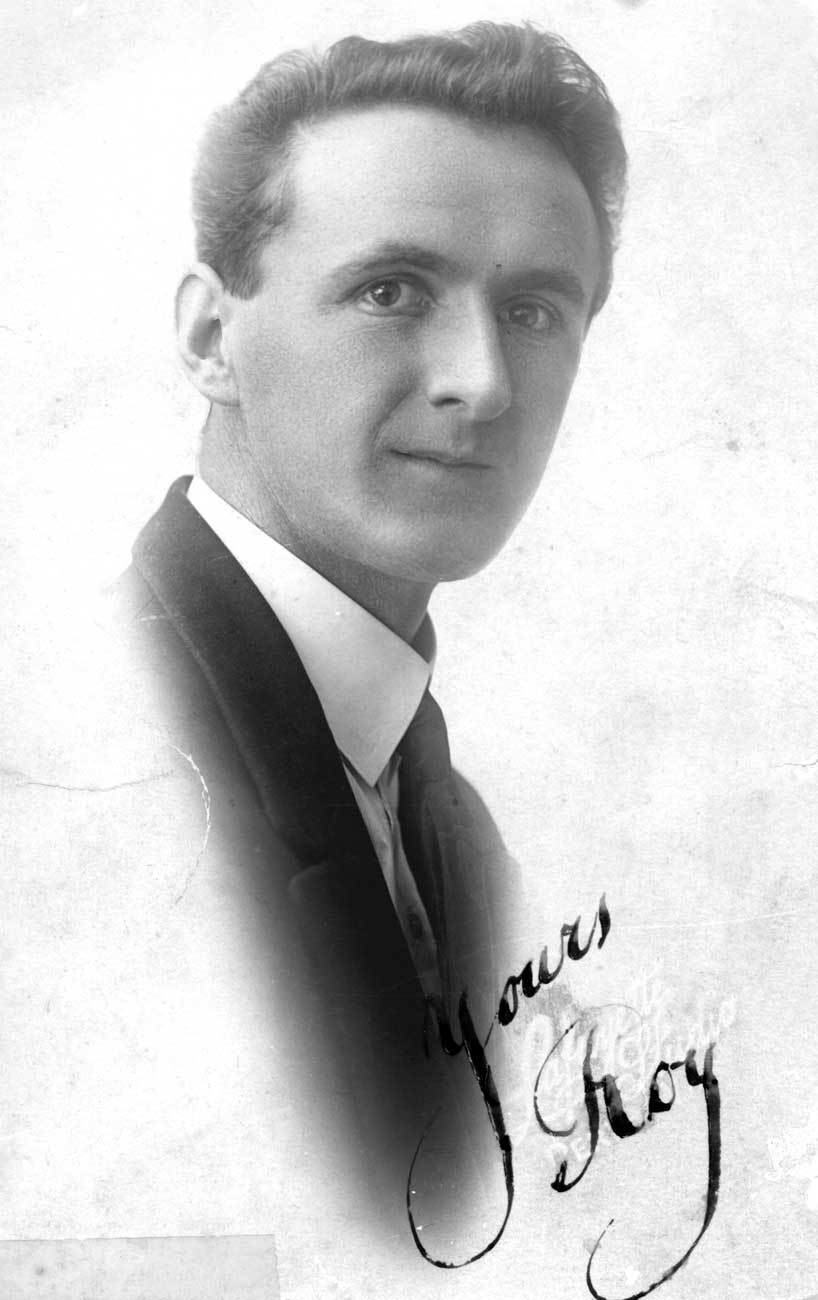
Born: 23rd February to Emanuel Brandstater Jr and Wilhemina Darko in Collinsvale, Tasmania, Australia
Married: Frances Eastwood on 5th January 1926 in Perth, Australia
Children: Rhona, Bernard John, Murray Everett and Lynette Frances Passed away: 23rd March 1983 in Redlands, California
Roy was born in Bismarck, now Collinsvale, in Tasmania in 1898, the last of eight children of Emanuel Brandstater Jr and Wilhemina, both immigrants from East Prussia. He married Frances Eastwood from Kalgoorlie, daughter of an English immigrant James Wilkinson Eastwood and Louise Everett, in 1926. They had four children, Rhona, Bernard, Murray and Lynette.
After attending primary school in Collinsvale, in 1914, at the age of 16, Roy traveled to Cooranbong, NSW where he attended Australasian Missionary College (Avondale), graduating in 1920 from the ministerial course. Roy’s life was committed to the Seventh-day Adventist Church which he served as evangelist, church pastor, conference department head and missionary until his retirement in 1973.
For the first 10 years of his professional life, Roy worked as an evangelist in country towns throughout Western Australia, reaching out to the public by advertising meetings to be held in a large tent or rented halls. He worked in Albany, Manjimup, Kalgoorlie, Boulder City, Merredin and Perth. It was in Manjimup that he was able to establish a new church which he personally constructed of wood with his own hands. He also established a new church in Merredin. In 1931 he relocated to northern NSW where he continued his evangelistic work in Kurri Kurri, Weston, Cessnock, Maitland, Tamworth and the suburbs of Sydney. During this time he took some photography classes and with a special camera he was able to produce large glass black and white lantern slides that were hand tinted in color by his wife Frances. He used these slides extensively to illustrate his evangelistic presentations. He was sent to Woollongong in 1938 where he had another successful mission and was responsible for construction of a church building that was dedicated in 1940. From 1941-3 he conducted his last evangelistic campaign in Bathurst.
From 1944 to 1952 Roy served as head of the church conference departments of Youth and Sabbath School in Adelaide, South Australia and then moved to Melbourne to serve as pastor of churches in Ringwood, then East Prahran and Fern Tree Gully, all suburban churches in Melbourne, Victoria. Rather than retire, Roy spent 2 years as church pastor in Bulawayo, Southern Rhodesia (now Zimbabwe), and six months pastoring in Nicosia, Cypress. Finally in 1969 he relocated with Frances to join their four children in California where he served for three years as pastor of the SDA church in Fallbrook until he retired in Redlands.
Roy’s wife Frances contributed greatly to his success in the ministry. Roy had a musical flair, and embellished his meetings by playing his cornet or singing solos in his fine tenor voice. Frances would play the piano for community hymns or accompany him as he sang. She added color to his black and white lantern slides and painted many of his public advertising signs. And she was always willing to pack up her family and follow Roy wherever he was sent to serve. During his retirement in Redlands Roy started and directed a choir called Heritage Singers that specialized in Early Advent hymns and which gave performances in Southern California. Roy died peacefully in his sleep in Redlands in 1983.
Author: Murray Brandstater, son of Roy and Frances Brandstater
In preparing the manuscript I have stayed as close as possible to the author’s own spelling, capitalization and punctuation, adding only occasionally a clarifying word, always in square brackets. I divided some very long paragraphs for easier reading. The page numbering is mine – small Roman for the Preamble and Arabic for the remainder of the manuscript. The chapter numbers 1 through 7 are as FLB assigned them; I have added the others, setting them in square barckets.
The first seventy-some pages are the author’s final version after her many revisions. The pages now beyond these came to me in no logical order so I imposed a chronological sequence, keeping the author’s words and occasional repetitions.
What appeared intended as the last section of the original provided an added challenge: two typewritten versions were numbered similarly; treated the same topics though in at least two (possibly more) revisions and lacked section heads. I did my best with the chronological sequence, omitting only exact repetitions, and there were few. The result is some redundancy, a small monotony in so expansive a life story.
There were also several loose, unnumbered sheets of original text that came to me, but probably part of the whole. By cut-and-paste I integrated all this, kept a chronological flow, and closed with what appeared to be the intended terminal paragraph. Only exact duplications were omitted.
All of the original manuscript pages, hand and typewritten, numbered and unnumbered, await the care of an as yet unchosen family member. They are in the author’s sequence and in the imposed sequence described above. There are also versions that others have worked on. I have ignored them, dictating from what I saw as the original typescript.
Maurice Hodgen
November 2011 and September 2014.
“Monger’s Lake” – The name stared back at me from a large billboard on the green verge of a gravely foot path. It taunted me; pulled hard at my memory. Was it such a place as this of which my father had dreamed when he said: “Someday, Lou, we’ll build a house beside Monger’s Lake”?
Never did my parents build themselves the house beside a lake, certainly not Monger’s Lake, spreading its shallow waters beyond a slight ridge from where I stood, spring-fed, and coeval with Time and its passing, it had survived forlorn hopes and purposes of man, perhaps even my father.
Yet by some twist of Fate it had drawn me to its side, inviting me to rest awhile, and I came willingly, dropping my bicycle and stretching myself beside it on the green sward.
It had been a tiring day. Looking back across the domestic landscape scene from which I had just cycled I gazed on drab streets filled with people pinned down close to the hard earth, spending their lives in living in “little boxes, by the lakeside; little boxes made of ticky tacky; little boxes on the hillside; little boxes, all the same.”
Not all the same to me. During the hot day I had visited many of those little homes, opening gates, stepping timorously inside fences with a warning sign, meeting housewives and their curious/inquisitive children, listening, talking. Ordinary people, each one wrapped within her own small world of light and shade, joy and melancholy discontent, a world differing from mine only in the circumstances which had conspired to make me that day a part of my own self-disciplined program.
Resting on that grassy knoll I could see the fresh water lake, not a ripple on its limpid waters.
Unbidden, the past flashed on “that inward eye which is the bliss of solitude”, and one by one the events of just one month filed past, much like the ducks softly gliding behind each other along the rushes at the margin of a lake.
On the eve of my twenty‑first birthday just three weeks earlier I had farewelled my mother, my sisters, relatives and friends, my birthday Globite suitcase packed to capacity, and joined the Kalgoorlie Express, on the first stage of an adventure filled with imponderables for which no road or rail map was provided. I knew the name and position of every rail siding; each rural community through which we would pass; the eight pumping stations and watering spots where the Puffing Billy would awaken the sleeping passengers with its burst of steam and its shrill whistle. Each one of the 17 hours of travel was taking me further from the only home I had ever known.
I was too excited to be sad; too uncertain of the future to plan; too lonely to interpret the flight of emotions of the night. A friend would be meeting me in Perth; I would chart my course from that point.
Mrs. Adam Baird’s warm welcome on the bustling railway station in Perth was reassuring. By tram we travelled to her home, then to a small lodging room in West Leederville, where I, who had been sheltered for so long would experience the challenge of making my own way in a path of my own choosing, surely like the mystical “arch where gleams that untraveled world, whose margin fades forever and forever when I move….” I was not of the breed of Ulysses! I was no Grecian hero. I was but a mere untrained, untraveled girl; but new in faith, hope, and in love! I know of no more rewarding nor victorious an arrival.
Within a day or two I visited the headquarters of the Church, and was interviewed, and refreshed in spirit. From the hands of an enthusiastic man I received a book of rules for beginners, a supply of religious magazines, small topical books, and a prospectus for a larger Home Nursing book for which to accept orders for future delivery. Unthought-of, unsolicited, from the sheds of the Church offices came a lady’s bicycle! That was a long-deferred bonus. All through my early school days I had longed for, and prayed for a bicycle of my own. At no time did I own one.
Life abounds for such pockets of unrequited longings, secretly waiting for the key, which fits! Now I had the key! With the idealism of a new-found Faith I accepted the use of that bicycle as a God-given answer to my most obvious need for transport and portage. I could not have covered my assigned territory without it, newness of outlook came unbidden, a natural component of a two‑way contract I made with God: An attitude of mind perhaps too fragile to be long-lasting. While it stays it is beautiful to experience: A joy to have known.
Into the rear carrier of my bicycle I stacked my stock-in-trade, and became one of a team of colporteurs already threading their various ways through other sections of the City and country towns. Few in number, of mixed ages and backgrounds, most had some specific goal in mind, such as a future college career. Some were stalwarts, spending their years selling the books of the denomination and a personal drive of spreading the Gospel to all the world and in their small corner.
At that time I had not established a goal for myself. I was just assigned to sell books; good books, religious books. I had been assured I would develop confidence, gain experience, and make a token living – in that order.
I was now on my own, dependent on my personal efforts and my ability to adjust to a variety of people of different personalities and situations to work with a will, and to leave behind a good impression.
Never before had I sold anything, not even a raffle ticket for a deserving cause. Little wonder mother questioned my choice of work. I sent her an encouraging report after one week, seeking to impress her that there were many ways of satisfaction and well-being, that I had found one already. All was well. After two weeks I was moving along city streets with a confident air; I had no regrets.
Still dreaming by the lakeside I recalled the day of my baptism in the Perth Seventh-day Adventist Church, receiving the right hand of fellowship, and resolving that I would become a share partner in whatever activities or help I could offer. I had made my decision. I would honor whatever I had promised.
Since then, each day had been occupied in learning my craft, sometimes rewarding, sometimes accomplishing little, like every undertaking of life. The quality and variety of responses was stimulating; the cash returns lean; tomorrow’s hopes always rosy.
Why should they not be? Did I not have in my bag a letter from Roy telling me he would be arriving in Perth on that morrow?
He had returned to Kalgoorlie to pack his goods before moving to a new assignment in the South West of the State. His letter told of a round of visitation, and of calling on mother who received him graciously. He took a small Easter gift for my 4-year-old sister Monnie, and had written a little dizzy for her alone. He told them of a transfer to a small town of Manjimup, and that he was to spend a couple of days in Perth en route. He would meet me there, and would assist me with any plans I cared to make for the future.
I sensed mother expected to hear more of that “Young Mr. Blankslatter”, as she later wrote of the encounter.
Yes, tomorrow! Roy would be here tomorrow, and what better time for day-dreaming beside Monger’s Lake, for was he not a part of those daydreams too? With the shadows lengthening, I gazed once more across the landscape of narrow streets and ticky tacky houses, and was thankful that my parents had not built a home there too.
Those people would never know the delicious unpredictability of the place where I was born, where there was always the promise of gold beyond the far horizon. That had been the hope of my grandparents, of my parents. I too had been cast in that mold.
Now, in some strange way, I had discovered that which glitters is not gold; the golden age comes only to those who have forgotten the Gold itself; to those who have found it in things of eternal worth, faith, contentment, love. The gold mystique lives on, despite one’s moralizings, but I now knew only that I had something of true worth – I had a faith to live by, and the love of a very special kind of man!
Calm was the lake and peaceful, flicked now with rose and gold at the day’s closing. It was time to mount my bicycle, to pedal up the hill, free-wheel down to its base, swing around the corner and reach the gateway of my home. It was good to be alive. Tomorrow I would be on the railway station as the train chugged in! I would pack a lunch for two, the first meal we would enjoy by ourselves alone.
Early next day I joined the expectant crowds as the engine huffed and puffed, its carriages bearing evidence of the long journey, of soot laden smoke from the hot engine. I watched the flurry of disembarking travelers greeting friends; the rear goods carriage disgorging stacks of passengers’ luggage – woven straw dress baskets, tin trunks, even an occasional Globite suitcase like mine.
I watched the copious drafts of steam issuing from the still panting engine, and in an inspired moment of Time was one in spirit with the French Impressionist painters of another day and age, seeing through their enchanted eyes the smoke-laden atmosphere, the billowing clouds of murky steam, twirling to the high-vaulted dome of Gare Saint Lazare or other French railway stations of their day. The rolling action, the moving play of light and shade fired their imaginations, and they captured it on their broad canvasses, a rich, diverse legacy for our day. Heart of the people joining the platform? The children? They were just a setting for such a scene, just background, mere blobs of paint! The one I waited for that day was no mere blob of …………….. I waited patiently. He wore on a vast substantial smile, a smile worthy of the brush of Artist Monet!
Romance stays for so short a time. Within two days we were back once more on another platform, waiting for the shrill whistle of the South-bound train to announce the departure for Bunbury, Bridgetown, and by way of the Timber Company Rail, to Manjimup and Pemberton, the end of the line. With a promise to write frequently, a kiss and a final wave he was gone once more. I made my way to the tram and was soon back to my small room.
My bicycle was still waiting. The drab streets were still waiting; the ticky-tacky houses filled with housewives and children still waiting. There would always be gates to open, doors on which to knock, people to listen when they could, and questions to answer to the best of my limited capacity.
I know I had a newer song in my heart and a spring in my step as I tackled the task again, more determined than ever to make a success of what I had begun. No matter what I attempted I would never equal the audacious effort Roy was planning as he commenced the work then assigned to him. I believe the man and the hour had met. He was young enough to tackle the impossible; imaginative enough to try out new methods; willing enough to spend and be spent.
The project was part of a colonizing effort to bring thousands of British migrants to Australia to help fill the vast empty spaces; the opportunity granted each family a large section of land, dividing wide areas into numbered groups of 20 families each, and under experienced Government supervision, helped them to create their own farms. Known as the Group Settlement Scheme, it ultimately swallowed up 75 thousand people, scattered throughout the continent, and countless millions in capital.
The scheme was struggling to find its feet in 1924, when Roy arrived in Manjimup. Miles of forest land had been cleared. Shacks had been built, the newcomers experienced the feel of colonial living. Some of the land was already in cultivation; thousands of giant Jarrah and Karri trees had been felled, and new townships raised.
It was, in the words of Scripture, a land ready for harvest; the land for sowing the seed of friendship and helpfulness to the new Australians, a small army of ill-equipped settlers from the crowded cities of Britain. It was our task to perhaps help some adjust to new ways of colonial living, so vastly different from the crowded cities of their British homeland. The rough and tumble of colonial life was new, and loneliness a constant companion. It would take time and much effort on the part of all before so vast and imaginative a scheme would prove its worth.
Roy was but one of many who were endeavoring to bring help and support where it was needed, the only young minister (clergyman) working in the several Group Settlements within the reach of Manjimup. Before long Roy’s regular letters became an epic tale of daring, of innovative planning, of improvisation, of meeting and making new friends, beyond what I could have dreamed.
He had early secured accommodation in the homes of several pioneering families of the Seventh-day Adventist Church, drawing support from their strength, and encouraged from their loyalty in the tenets of the faith they had learnt long years earlier from the first evangelist of the faith to visit Western Australia, in the first years of this twentieth century.
In isolation these three or four families had stood loyally by the tenets of their new-found faith, and offered an abounding generosity to help a young evangelist become started in his ministry. From them he had borrowed a stout horse, and ventured into the virgin land, with its deep, wheel-rutted forest trails.
He wrote of visiting in the rough shacks of the new settlers, of calling together the children of the communities, telling them stories beneath any wide-spreading eucalyptus tree, of calling together any willing group for divine service in the open-air, or a mill company’s hall. From his account, it was high adventure at its pioneering best, hard work, but forever-changing interest and its rewarding results.
He developed friendly contacts with some of the local townsfolk in Manjimup, itself quite small, and in the usual way, outflowing in its helpfulness. In a short space of time, Roy was drawn into an honorary appointment as the local Brass Band conductor, playing with them when he could. These contacts opened up a wider range of interests and communal activities beyond the immediate scope of his principal concerns, his regular missionary effort amongst the Group Settlers in reachable areas of his territory.
With all the roads into the newly-developing land mere wagon trails, he soon owned a spritely mare called Tittle, and together they weathered the torrential rains of winter and the flower sprinkled trails of summer. His parish covered Manjimup, Jardinup, and the well-established timber town of Pemberton, where a large Company Mill was in full operation, and where were several pioneering families of the church. In the Mill Company hall he took turns sharing the Sunday pulpit with other visiting clergymen. Through the torrential rains of winter and the glorious wildflowers of spring time he worked and established a sound footing in the district.
There was soon an obvious need for a fellow worker, one accustomed to rural living, and with free-wheeling qualifications of an oldtime gospeller. Such requirements were met in a young man named Albert Markey, who shared with Roy the shelter of a rough built cottage on the outskirts of town, just beyond the reach of the electricity services, and postal and other civic amenities.
A second horse was purchased, as no other means of transport could have traversed those rough tracks. Soon the missionary outreach was accomplishing what it had set out to do, and families were regularly hearing the same Bible truths to which I had listened, and were enjoying fellowship with Church members in Manjimup and elsewhere. They were learning to be at home in their adopted land.
This was part of the story around which my daydreams were now assembled. It was in the best tradition of pioneering, vastly different from the Goldfields which I had known. I was to hear firsthand with Roy’s visit to Perth, when we were able to make more definite plans for our future.
During those canvassing months I had found opportunities to visit mother’s second cousins, the Hawkens, relatives of a great-aunt Alex, whose basketry wonderland had charmed me as a child. While I recalled the visit to Uncle Donnelly’s visit to Scotland on the hunt for some possible inheritance due to my grandmother and her sister Alex, and it was refreshing to review the past with the family once more.
At mother’s request I had sought out and visited her relatives, Great-aunt Alexandrina Donnelly, then widowed and living in the home of her eldest daughter, mother’s cousin. The Hawkens family offered me lavish hospitality whenever I could visit their home, and enjoy a Sunday meal around their long extension table, and the company of their large family of bright children.
Now I well recall the only time I had met Uncle Donnelly, when he was highly stimulated at the prospect of an inheritance from some distant relative of the Campbell Clan, to which my grandmother and Alex belonged.
Of special mention also the visits with the Hockley family, whom I had first met in the little Mission Tent in Varden Street, Kalgoorlie, when I was about 18. With the constantly failing fortunes of the goldmines of Kalgoorlie, the Hockley family had moved to the country areas surrounding Perth, and on the banks of the Canning River had carved for themselves a flourishing market gardening business.
Beautiful for situation, their simple home was a haven of restful abundance for me, carrying with it memories of past friendships, and the light-hearted effervescent atmosphere of their happy home and family. It was a delight to sample the joy of simple living.
We rode to the country Adventist Church at Gosnells each Saturday morning in a large dray or cart, ate with genuine relish a packed luncheon by the river, joined a Youth-oriented afternoon program supplied by clear-faced young people under the direction of their elders. Then it was home in time to milk the cows, collect the eggs, and early to bed in readiness for a Sunday work-out of the entire family in the cabbage patch, the plots of beans, potatoes, tomatoes – anything in season. It was a try-out of the Good Earth at its best. A fillip to jaded canvassing nerves or family-hungry ****!
During those long months I had been working through my assigned territory, and extending it, less exciting, save as I made a determined effort to extract the maximum from each day’s work. My cash returns were just sufficient to cover expenses, but I was happy and in good spirits.
My Kalgoorlie friend, Dorothy Gray, had decided to join me in Perth for a term of colporteur work, while she awaited the arrival of her widowed mother and family. Dorothy was quiet and self-effacing, with no career beyond the career of a home, and I felt she might wilt under the stressful demands of the door-to-door canvassing. Nothing daunted, she arrived, and I moved to larger quarters to share what accommodations I could with her straining my own irregular income. I know I rested in the promise of the Book, so often glibly quoted, “The Lord will provide”. I put it to the test, and He did ! Within a month I was invited to join the offices of the Church headquarters in West Perth.
After almost eight months of canvassing I was invited to join the staff of the headquarters office. I was again seated behind the typewriter and a desk, secretary to a departmental leader, doing that for which I had been trained, gainfully employed with an assured income, albeit, a meager one, in keeping with the depressed times. I had little money, but no debts. I had made friends, and gained experience. I was fulfilled and very happy.
And all the while Roy’s saga of his pioneering adventure brought satisfying emotions as I waited for his periodic visits back to Perth. When I had first commenced to work in the Church office he had made a rushed trip, mainly on Church business, but providing opportunities for a wonderful few days together. Roy had but once come to visit me in Perth, so engrossed was he in his program of activities in the Timber belt. On that happy occasion we met as often as possible, and splurged our cash savings by way of a quietly arranged engagement celebration.
We made our plans for marriage in January 1926, choosing a college friend of Roy to seal the contract.
Roy and I decided to splash out on our first joint enterprise – the purchase of a beautiful, second-hand Wertheim piano, combining our bank accounts – twenty-five pounds each! The purchase was buttressed by my promise to practice faithfully in readiness to play any accompaniment from the wad of sheet music he left in my care.
Dorothy’s mother had arrived in Perth and was just getting up home of her own. The piano was taken to Mrs. Gray’s home and I moved there too, the better to carry out our promise to work on that ivory keyboard.
Roy’s visit set the seal on our engagement and wedding plans, encouraging me to branch out further and to coax from the Singer Sewing Machine, treadle model. Before Roy returned to his wide-spreading parish we added this second joint venture, easily contrived by each of us sharing the initial deposit, and a monthly installment of 16 shillings.
While I now write it, for sweet nostalgia’s sake, I must spare a word or two for that sewing machine. I find it difficult to decide if I were an old-fashioned bride-to-be, honoring the tradition of a home-sewn, hand-crafted bridal trousseau/or if indeed I represented the pre‑synthetic era of a time which knew nothing of the audacious wisps of diaphanous lingerie, held in reserve for a more modern generation. My old-fashioned approach to the unalloyed pleasure of assembling a trousseau of cotton cambric and muslin belonged to the pre‑synthetic era of time. To the delight of an age of practical brides, a silken fabric known as tussore or fuji silk, plus a softer variety called crepe-de-chine had just reached the markets of the world. How we pounced on these.
This I know: I worked that Singer treadle sewing machine hard, hemming sheets, making pillowcases, embroidering pillow shams, sewing petticoats, nighties, and unmentionables, all in cambric cotton, muslin and soft calico, known as long-cloth. This also I remember: I explored the possibilities of an early intruder into the world of fabrics: tussore and fuji silk. Nylon and the vast array of synthetic fabrics which followed in its train were beyond the realm of thought.
As the completed items began to pile up, I was aware of the need for a Glory Box. Providentially, Roy arrived on the scene just in time to save the situation. On a hurried visit to Perth, Roy went on the hunt to satisfy my extraordinary request, guided by an uneducated knowledge of brides-to-be and their demands. He soon returned carrying a cumbersome wooden box carrying the identifying stencils of its original contents – dozens of Marmite jars from Stoke-on-Trent, England! Nothing daunted, Roy sawed and hammered, added a suitably hinged lid, and, presto! I had the most solid, commodious Glory Box in all the land! At least I could rightly claim it was a hand-crafted model. That versatile box survived the long years filled with blankets and linen whenever we were called to pull up stakes, nor has it yet out-lived its usefulness for in our California garage it now holds a supply of household tools in constant demand. The favored man or woman given the talent for improvisation in every straightened circumstance is blessed, especially if he be a hot gospeller sent to practice his calling in a pioneer land.
That Red Seal Singer Treadle sewing machine holds a special place in my memory. No more productive an instrument was ever made by us, nor did we part with it until the year 1964, when we gave it away. It had served us long and well.
Those two purchases, the piano and the sewing machine, became the foundation on which we were the following year to establish our first home in the magnificent timber belt of the West.
So small, so simple such enterprises now seem as I in retrospect recall them. So wonderful full of promise and hope they were when I was scarcely 22, and in love with a wonderful man!
It was just one year since I had attended the Camp meeting, and had decided to join with a people whose way of life had so impressed me, and to which I had dedicated my future. It was Camp time once more, this time under different conditions, for I was a working unit of the Church, happy in service, and engaged to be married to one in whom I reposed my full confidence.
So the months passed for both of us, he in his large corner, I in my confined sphere of influence, but both of one common thought, of a time when we would commence our lives together, and declare our truth before the marriage altar of the Seventh-day Adventist Church in Perth.
It is impossible to approximate my own experience or to measure my development or change of direction. This I know, I entered into every area of the Church’s plans and purposes, and with each enquiry became more confident and assured of the Truth of its claims. I was sublimely happy that I was soon to be a more active member in service.
We set the wedding date, 5th January 1926, and made our plans, simple to a fault. We had chosen as a celebrant a college friend of Roy, then a Youth Leader in the west, by name, Harold J. Meyers. It would be his first nuptial service. Though Pastor Harold Meyers was a gifted preacher, his wedding performance was in the low key, at our bidding.
Mother made my wedding dress, but at no time did I aspire to be so regal and beautifully gowned as was she! Married in the year 1902, she had designed and made her own beautiful gown, with its frothy, swirling hemline and sweeping train. She belonged to a romantic, elegant age. In 1926 I was also part of my age, wearing a simple calf-length, trainless dress, paying my dues to the current foibles of a short-lived tasteless fashion. My wedding dress was cream crepe-de-chine.
Why is it that most of us dance to the piper of fashion!
Mother made my two-tiered wedding cake, which was artistically iced by the young minister’s wife.
I had asked mother’s cousin, Uncle Hawkens, to act as stand-in place of my father, assisted by his son Jack, and with the help of my sister Marjorie as first bride’s maid, and a cousin Alice Bennett. The ever-loyal Albert Markey served as best man, his last act of helpfulness, for he was to leave the Group Settlement Ministry following the wedding. The wedding feast was spread in the humble home of Mrs. Gray. The simple wedding plans were complete.
I had dressed for the occasion in the Hawken’s lovely Mount Lawley home, where bed‑ridden great-aunt Alexandrina gave me a matriarchal blessing, whispering, “You are pale my child. You must have a glass of my special blood tonic to bring color to your cheeks.” Soon a Glass goblet was handed to me, and I quaffed it down, the while praying it may accomplish its purpose – rosy cheeks and a sparkling eye. That fragrant “blood tonic” of my dear Aunt had a sweet tangy flavor – and aroma of fresh-pressed grapes! What better tonic for a wedding day?
As we drank a wedding toast, this time not-so-tangy grape juice, Roy whispered in my ear: “I’ve been up since sunrise – at the markets – buying fruit for the fruit salad – helping to churn the ice cream – I’ve had two shaves today!” Tradition has it that he regaled the market merchants with [a] rollicking melody.
Much of the early history of the Seventh-day Adventist Church in the South-West corner of the State is tied up with the history of such missionary gospellers as Roy and his fellow worker Albert Markey, and others were soon to follow. I shared it myself by way of a regular flow of letters and by word of mouth. More important, earlier in the year 1926 I was able to become a share partner in so unique an effort of evangelism. So rare an opportunity seldom comes to a new bride – to experience life in its uncomplicated aspects; on the threshold of a modern world, yet still with its feet in the past.
My early background on the Goldfields in Kalgoorlie set its seal on my life forever. I quote to myself the Scriptural admonition, “Speak to the earth and it shall teach thee ….” and I do just that! On the surface of the earth with its craggy mountains and its pebbly river basins; in deep copper mines or shallow probings of the earth’s crust I know a strange exhilaration and stirring of other days, and I feel young again.
Yes, it was the Message I heard in the little two‑pole tent in Vardon Street, Kalgoorlie which changed the direction of my life, and set my feet on something much more valuable than any rich ore from the land of my birth, if one can measure the things of eternal worth, the gold of faith, hope and love. This is my confession of true faith.
All would be well in the end! Marjorie and I had work to do, at a time when others were less fortunate. Mother had many friends and a few relatives, and the care of a small child. She managed bravely, directing Kathleen and Jean as she could, while I found new interest in my work and in the many new friends of the Tent family I had learnt to appreciate.
Meantime, my friends of old drew me into the sport of tennis and sometimes ventured with me to the meetings in the Tent, always with an uneasy sensitivity and lack of response. Jean accompanied me just once; she was probably ten years of age, with long, fair, plaited pigtails. She was pretty, and I was proud of her. She listened attentively to the evening discourse, not understanding it, but noting the appeal solo at the close of the meeting. She questioned me about it. “Why did they set the rabbits free?” Who can ever understand the thoughts of a child? The song was based in an incident in the trial of Christ, when the Roman Pontius Pilate had asked the avenging mob, “Shall we crucify King Jesus and set Barabbas free?” Such a question was strange to a child, but we all knew that rabbits were a destructive pest in the agricultural areas throughout Australia. Rabbit-proof fences had been strung across the length and breadth of the land, poisons and traps set everywhere in a futile effort to eliminate the pests. It was to little avail. If ever they were caught – they would never be set free. How could a 10‑year old girl, unversed in the multitude of Bible stories understand so vague a question? I also had much to learn, not only in Bible stories, but how to answer my own uncertainties in many simple questions.
One day the missioner and his young helper dismantled the Tent on Varden Street, packed their belongings and were off to the Port of Albany on the southern coast of Australia. We were told that another preacher would welcome us to the little Church in Cheetham Street each Saturday and he would answer more of his listener’s questions, delivering a message similar to that we had enjoyed so much in the Tent. This new arrangement presented an immediate problem for me for I was at work each Saturday morning in my office, enjoying my work and forever learning more facts and foibles of human nature.
Indeed, I had talked to Tasman Williams of my current interest in the unfolding of Scriptures, but he concluded it was a passing obsession, and countered my every argument, lawyer–wise. Even though I was unimpressed, I was unable to answer his persuasive rhetoric. He had unsettled me, shattering for a time the faith I had accepted in the Scriptures, and in the people of the Tent, whose friendship I had sought and valued so much. He found fault with so many of their restrictive ideas; their adherence to the Jewish Sabbath, (one point in which I felt I had countered his every argument); their dietary fads. I knew I was half-tutored, and not yet captive to every new-fangled proposition such as those practiced by the little-known Church community, vegetarianism, for instance. They were at odds with the world – at odds with what we had always known at home, that one must eat a daily portion of good red meat to be strong and healthy. Then, how rigid they were on theater-going, on gambling, even smoking, which I did not practice. Putting all such trifling matters together, I tested my reactions in a childish experiment, perhaps unworthy of a place in memory, and certainly not deserving of place in my life history. I’d indulge in some minor gambling! The mildest form of gambling! In fact, I wasn’t convinced it really WAS gambling. I purchased a sweepstake ticket in the up and coming Kalgoorlie Cup, the climax of the Goldfields Racing.
On Kalgoorlie Race Day, perhaps 1923, I purchased a sweepstakes ticket under the nom‑de‑plume of “Vegetarian”! My horse, “Warpath”, did NOT win the sweepstakes and the hoped‑for large prize! Showing my then valueless sweepstakes ticket to the ever-ready law clerk, he said, “Vegetarian? Why did you call it that? IT WOULD NOT WIN. No vegetarian ever carries off the stakes!”
Too ashamed to explain anything, I tried to forget how stupid, how infantile I had been. Surely I had poised sufficient to settle my doubts and uncertainties, and commenced faith enough to believe that “The entrance of Thy Word bringeth light.”
For many months I did not visit the little Church in Cheetham Street, but spent time with my old friends of other days. However I had made many new friends whom I visited on occasions, and had a sense of fulfillment and confidence gained throughout the Tent mission experience, the study of the Scriptures, and the friendship of a devoted group of people who had discovered a Faith by which to live.
Despite Kalgoorlie’s falling fortunes, the district was a factor to be reckoned with. That year the town prepared for a visit of Royalty in the person of Edward, Prince of Wales, Heir Apparent to the Throne of England. Nothing is more calculated …..the colonial fervor than a touch with Royalty.
There was active promotion – British automobiles were to seen along the new macadamized streets of the cities of Australia, the Morris Cowleys, Morris Oxfords, the Austins, even at times, the top-liner the Rolls-Royce. But could those British cars keep pace with the new assembly-line Fords and Dodges, advertised in the “Kalgoorlie Miner” of those times for one hundred and sixty pounds ten schillings for the Ford and the latest Dodge with five balloon tires at three hundred and forty-five pounds? In the light of today’s automotive world an enigmatic smile is the most appropriate response.
However the Goldfields were not behind in world affairs. Our main streets were now macadamized, but horses and carriages could still be seen beside hitching posts and troughs along the side streets. A year or so earlier the first aeroplane to be built in Western Australia a strutted bi‑plane with Gnome engine that had been put together at the Kalgoorlie School of Mines, took off from Kalgoorlie Racecourse. Piloted by a local man, it circled the Golden Mile in a twelve‑minute flight.
As for me, my first close-range view of a lighter-than-air machine occurred on a Sunday afternoon walking jaunt with my friend Ida Giles. Anchored securely to the lawns of the Kalgoorlie Racecourse and piloted by a wartime flying ace, Norman Brearly, it was a frail-looking bi‑plane which Ida caught in the lens of her box camera Kodak. The resultant prints, was some of a more personal snapshots of girls in wheelbarrows, are linked to those days. Such snaps are a frozen capsule of Time, choice moments of life immortalized on sensitive paper, to be recovered at the whim of a moment.
Since the mission Tent had been dismantled I had occasionally attended the traditional galvanized-iron Church on Cheetham Street, always for a Youth program on Saturday afternoons. There I kept desultory contact with those I had learned to respect, and, in particular the then minister, one Pastor Britten, who with his talented wife, carried on the earlier program of worship. His home was open to visitors, and I often shared their friendship and hospitality.
To reach their home, I crossed the railway line still serving the functioning towns in the North. Gone was the golden glow which had brightened the earlier years. I had cause to pass by the Open Cut goldmine still known as Hannan’s Reward, where gold had been first spotted in the year 1893. Beside the road were thinly-covered shafts, piles of rubble, and here and there idle overhead mine workings, sad relics of a day long gone. There in Kalgoorlie lay bare the frustrated efforts of many a miner, for the passing world to see – and consider.
One night Pastor Britten told me that he was leaving the district, and that a younger man would come to step into his shoes. His name was Roy Brandstater. Ah! That was better. He was young enough to tolerate my unstable attitudes; to face up to my questionings – if he had sufficient patience.
With the departure of the Britten family I felt a strange sense of loss. Mother and sisters were then occupied in their varying interests, patient with my unaccountable preferences, and my continued interested in the little Church. I still retained my friendship with those I had known from my school days, and shared some activities with them when I could.
I felt strangely like the fictional character who jumped on his horse and galloped off in all directions. I knew I must face up to life’s realities eventually. Perhaps I should gallop back to the Church, and meet the young man who was filling the gap in the Church pulpit. That I did.
I found him friendly, noticeably ambitious as he made his entry into his chosen field of service, public evangelism. He early announced that he would be commencing a series of meetings in the Boulder Church on Sunday evenings, and invited his congregation to support him by their presence.
For me that was stalemate. Boulder was probably four miles from my home, served by the rather slow moving trams. My friend Ida Giles, had no wish to accompany me and I tarried awhile. However, I eventually enlisted the interest and support of my old friend and neighbor, Isadore Masel, feeling his Jewish background had conditioned him to be receptive to the words of the ancient Hebrew scribes and the fearsome visions of Daniel the Prophet.
By the close of the first evening’s lecture in the Boulder Adventist Church I felt it was the first occasion my Jewish friend had ever entered a Christian sanctuary, and certainly the first time he had read the story of the horned, non-descript creatures portrayed so vividly. Isadore decided he had no wish to attend further meetings, but my own interest had been awakened and despite the distance, I often was to be found seated on one of the hard pews.
At the close of the series of meetings I met the young minister, generally in the home of mutual friends. He had a fine tenor voice, and was an expert on his silver trumpet-model Conn cornet. He had graduated from a College in New South Wales, and offered his estimate of its worth to him in words of unstinting praise, well worth remembering. “Avondale made my life. It gave me purpose and incentive. It opened doors into the future, and showed me how to live and serve.”
Wasn’t that just what I myself was seeking. I watched him, noting his interest in the young self-satisfied members of the Church, endeavoring to help them attain satisfying careers of their own. I liked that. I knew I could also reach beyond myself if I just stuck around.
This, then, is the simple story of how I met the man who was to become my husband, and of the convoluted course by which we had met.
I knew why he had chosen the profession of a preacher, devoting his life and talents to a program of public evangelism and pastoral ministry, and the less than ideal conditions. His background had prepared him in advance of the need.
However, there were few opportunities for us to discuss any personal interests. We always met in a general gathering, or in the Church or hall, always with due reserve, as from the stilted arena of a counselor to a learner. There was watchful restraint on his part, which was relaxed when we met at a Watch Night service in the Anglican Church on New Year’s Eve, 1924.
For years past I had attended that mid-night service, listening to a brief topical exhortation from the pulpit, then the joyous ringing of the Old Year, and the exultant chimes of the untried New Year. It was always a time of traditional celebrations, of making new resolutions.
That night, 1924, was different. My friend, Dorothy Gray, had asked to accompany me, and whether or not the new minister knew our plans, we saw him wheel his bicycle to a safe parking spot and enter the Church. Then he sat down beside us. We learnt it was his first-ever Watch Night service and he agreed it was a delightful and fitting way to welcome the New Year, which he hoped would be full of promise.
He walked us both home, Dorothy to her front gate, and a few blocks further on, to the corner of my street, his uncomplaining bicycle measuring out the extra distance. It was the first of many occasions we met to talk and walk together.
At my request he told me of his background, so totally different from my own. It took on the nature of a magnificent pioneering adventure. That he has now written his own memoires from material from existing family records should not hinder me from recounting in utmost brevity the sketchy outlines as I know them.
The Brandstadter (original spelling) odyssey commenced in or near Konigsberg, somewhere in the land of ever-changing borders twixt Germany, Russia, Latvia, and Lithuania. Of German origin, Grandfather Emanuel Brandstater, age thirty-seven years, his wife Caroline, thirty‑one, and their three children, Emanuel Junior, Gustav Adolf, Carolina and Herman, joined a shipload of emigrants in Hamburg, Germany, and sailed from their native homeland in October, 1871. After five months of indifferent conditions in the sailing barque, “Eugenie”, we tied up on the deep‑sea harbor of Hobart, Tasmania.
From that time onward through the years, the Brandstater family fended for themselves, increasing in numbers, and carving out homes in virgin forested hills some twelve miles beyond their port of entry.
According to a contract now in the Archives Department of the Tasmanian Government, Emanuel Brandstater, Senior built the first State School in the town of Bismarck in the year 1877 for the sum of one hundred and ninety pounds. His children grew up young Australians, yet preserving the national heritage in ways of life and culture. Emanuel Junior appears to have spent much of his life in the heavily forested hills country, where he married and eventually became the father of eight children. Roy Brandstater was the youngest child of that marriage, attending the country schoolhouse originally built by his grandfather.
Possibly it was an average story of migrant settlers, but to me it became a heroic saga of resourcefulness and ingenuity, a story of stalwart Protestant faith and eventual conversion to the Seventh‑day Adventist persuasion. In the year 1889 the family and friends became the prime movers and builders of a Seventh-day Adventist Church on a large section of land, a gift of the maternal grandfather.
With such a background it is not surprising that when Roy’s primary education was completed in the little Bismarck schoolhouse, he would join his older brother in the denominational College, Avondale, in New South Wales, where they could advance their education and fill their chosen calling.
The friendship between Roy and me was never the same after that special New Year Watch Night service. We found opportunities to meet together, to walk the quiet sections of the town, he with his inevitable bicycle by his side. There were things with which we did not see eye to eye, and much in which we both agreed. We reviewed the period since I had met with the Church; the interest I had shown; the convictions with which I had wrestled; but between us was always my lack of total commitment to the Church which he served.
He told of an up-coming Camp Meeting and Conference Session which demanded his presence, and to which all members of the Church were freely invited. Several large marquees would be erected to provide suitable speaking accommodation for visiting preachers coming from other States and overseas, and hundreds of spacious dwelling tents as comfortable as one cared to make them. He posed the obvious question, “Why not make it? Why not tent with your available friend, Dorothy Gray?”.
I was interested, approaching Tasman Williams for ten days’ vacation in Perth, which was granted without further questioning, which I was not anxious that he indulged. I talked the matter over with mother, which added to her conviction that there was no end to the novelty ideas that the Adventist Church practiced!
I know it would have surprised had I told of my blossoming friendship with the young minister. We were then in love, and though our relationship seemed sincere and rewarding, no question of a definite engagement had been discussed. That was wise, for our relationship/friendship could never climax in a lifetime together unless/until I was prepared to surrender my life to Christ, and share the service to which Roy was committed.
I had not at that time invited Roy to our home, which I now know, was palpably unfair. However, mother had been influenced by unworthy criticism of the Church by none other than the Anglican Archdeacon. That was his privilege, for he was about watching over the interest of his flock, of which I was one by confirmation. Such a petty matter seemed inconsequential to me, but I decided that discretion was the better part of valour, and I would wait a more convenient season before introducing “that Mr. Brandstater” to our home.
The well-organized Camp Meeting proved a wonderful success story, if such be judged by the responses of two Goldfields young women. Dorothy Gray joined the Church in company with her mother and sister; I much appreciated her companionship.
With hessian (burlap) wire-stapled to the ground, two wire-mattress beds, a table and chairs, and a couple of petrol boxes for food and incidentals, we were able to revel in the camp life with a degree of kindred comforts.
Rising bell at 6:00 in the morning prepared us for a day of diversified programs on a wide variety of subjects, offering a choice to every-one. The evening meetings provided the main thrust of the Camp, and were generally conducted by visiting speakers. Food was available, and little was left to chance. Without doubt, it was a time for making new friends of my own age, all happy and well adjusted in the faith to which they belonged.
The subjects I had heard before. The appeals to my heart, and the conviction of my good judgment, convinced me it was time to make a break with my past routine which had so long resisted change. I agonized with myself, and finally decided to join with a Movement which was destined to make its way in a needy world. I would approach Mr. Williams, to whom I was accountable in most things, and tell him frankly of my convictions. If deemed advisable I would leave home and make a new way for myself in another environment. I had gained a new purpose, a consciousness that there was “no limit to the usefulness of one, who, putting self aside, makes room for the working of the Holy Spirit in the life”, as one dedicated writer has said. I had been converted under the divine influence; where it would lead I did not know.
It was a small move I was making but it was the most momentous I would ever make. It changed my life. It took me to the ends of the earth in time, in distance, in consequences and to the ultimate in happiness.
“There is a divinity that shapes our ends, rough-hew them as we will.”
All the while I was happily settled in the offices of Felix, Cissel, Cowel, at first under the watchful eye of Miss Murdock, the senior typist, who made possible a smooth transition from the school room to the office desk, but who, with the early collapse of the Hampton Plains gold rush, had returned to her previous position in a Perth legal firm.
To me the developments were rapid ones. I was given her senior typist position and invited to bring to my vacant chair my sister Marjorie. She was a good all-rounder, delighted to be working in the same office as I.
Much can happen in a short space of time, especially in Kalgoorlie. The Hampton Plains gold boom had come and gone in a media-like flash.
I now had work to do in the most prestigious law firm in the Goldfields. I had learnt much of how a successful firm operates during a time of high tension, and then in times of recession. I considered myself a fixture in the offices of Felix Cowel, capable of handling some of the legal requirements of typing option agreements, leases, mortgages, probate affairs and the multifarious concerns of the Law.
At first the offices seemed austere, mildly forbidding. Later they were comfortable with their signs of usage through the hectic years of the Goldfield’s golden era. The furniture had an old-world, mildly antiquated look, an accepted corollary of the Law, even as grey hair adds a glory to old age. Lining the shelves of the front office were shelves stacked with ponderous tomes, within whose hard covers was the wisdom of the ages, the framework of the Law with its forms at precedents – so I had been informed. I had no inclination to prove such assertions.
During the 20 years or more of occupation, every available corner of those rooms had become stacked with documented clutter, obviously the output of a firm from the day he’d hung up his brass shingle at the entrance facade of the new Exchange Building in Hannah Street, where it could be read the legend:
“Felix Cessel Cowle. Barrister at Law; King’s Counsel; Notary Public; Commissioner for Affidavits; justice of the peace.”
That was intimidating, until one became acquainted with the honorable gentleman. When his black gown was hanging on its special hook and his white wig restored to its black box, he was approachable, friendly-like.
Also such considerations aside, time moved relentlessly on, as I fitted into the regime of the Law. I was now the senior stenographer/typist, assigned to record on paper the results of my boss’s judgments, opinions, directives in matters concerning the wide ramifications of the Law of the land.
There was some new lesson to learn; such as on the day I ruffled the serenity of the newly-elevated Bishop of the Anglican Diocese of the Eastern Goldfields, whose bounds of office stretched an untested infinity of desert miles. Oxfordian Syril Golding-Bird had already taken up residence in the family like Church mansion, “Bishopbourne”, there reigning in bachelor supremacy. His presence was required in our office for his commission to have the HYPHEN OF TIME whereon I must spend the sum of my years. Is it so strange an analogy that Time is a mere hyphen between two vast eternities, one of which stretches backward to the aeons BEFORE God set his Timepiece in the heavens and, the galaxies of Eternity AFTER the awesome Edict, “THERE SHALL BE TIME NO MORE!” The contemplation of such impenetrable mysteries engulfs me completely. The wonderful Present is all I have a sufficient matter for me to handle – even the pleasant hours spent in writing these, my memoirs!
Punctually the Bishop arrived, an august presence in long black spats, white starched bib and purple cravat. Completed, the type sheets of brief-sized paper went to the front office for reading and approval. Was it the startling livery of the Church, the aura of sanctity surrounding the prelate, the weight of my responsibility, [or] Mr. Cowle’s cramped handwriting, who knows? I fumbled it! I carelessly failed to type the hyphen in the dear Bishop’s name. There was an ominous silence in the front room, the flurry of words with overtones of dismay. Back to my desk came the typed sheets, with instructions to supply the missing hyphens. That accomplished, the document was signed and witnessed. With green silk binding tape I threaded together the title page, the newly typed material, then the backing sheet, splitting the two ends of the tape apart ready to receive a dollop of hot red sealing wax. From the finger of the King’s Counsel came his signet ring, to be impressed in the hot wax, irrevocably sealing the ends together. With the signatures of all concerned persons in place, the document was now delivered into the hands of the now-mollified Bishop of the widest diocese in the land.
The experience lived long in my memory. It seemed incredible that so small a matter as a missing Yost typewriter key was capable of causing a furor in the inner sanctum of King’s Counsel and his Bishop. On my part, it was unpardonable to have missed to type the hyphen. But the elaborate procedure was probably part of the pride and circumstance of the Victorian era pompously carried over to more modern times. Yet it’s quaint.
In retrospect the personal crisis of the missing hyphens is but one of the many varying experiences encountered within the enclosing walls of a law firm, each one capturing a capsule of Time. There was the affair of the turbaned Arab camel driver, a **** remain of a long past, who visited our offices for help, the charge being a serious infraction of the moral law. With solicitous concern for my feelings the law clerk himself, Tasman Williams, typed the full dirty facts of the case, later filing the Court’s verdict and all relevant matters. It was the only occasion I can now recall when Mr. Williams endeavored to hide my pure eyes from the actual facts of life. It didn’t, for I was, among other things, the filing clerk.
The majority of cases passing through my hands and reaching the Courts were matters of the mining industry itself, principally gold stealing, which provided full scope for Mr. Cowle’s gown and wig. I cannot now measure the worth to me of Felix, Cessel, Cowle and Company’s experiences during the four and half years I spent under their direction.
Mother battled bravely on, sewing for her family of girls, and adding to our reduced income sewing for others, purchasing a new Red Seal Singer peddle machine to take over the job handled through past years by her old turn-the-handle contraption on which I first learned to sew. Marjorie and I were at work in the legal offices. I was happily at work and keeping ourselves in pocket money, and we were managing well enough, but our home background was affecting in ways I failed to comprehend. Dancing had lost its old-time rapture, for suitable partners were seldom available. The silent movies provided entertainment, while the Public Library became the best escape for myself. I was young; two of my friends Alice Brearley and Ida Clift, had left or were planning to leave Kalgoorlie, as I knew I would miss our occasional games of tennis together.
I was looking for something to lift me from my self. The daily “Kalgoorlie Miner” brought the news of the day, and its columns provided an original idea. It was time I took an interest in the world around me, even beyond my pleasant office and its understanding principals. What interest did others follow beyond their daily work pattern? I would visit some of the advertised Clubs and Societies.
No sooner decided that it was accomplished. Other people had found ways and ideas unknown to me. Why not visit the Anti-Vivisectionists Society, which held meeting occasionally in a local hall? I did, and found dour-faced group of older people voicing their opposition to man’s experimentation on dumb animals, in an endeavor to abolish various death-dealing plagues and epidemics that man was heir to. I listened attentively to the only meeting I attended, then left members smug in their own superficial findings.
To even up the score, I attended the meeting of the R.S.P.C.A., the well intentioned Society aiming at the Prevention of Cruelty to Dumb Animals: an idea well supported by Royalty. They were a more joyous group, hell-bent on protecting their pets from the same experimentation on animals! We had no pets, and my interest in such matters waned.
I soon chanced on something more helpful, the R.S.L., Returned Soldiers League formed by returned men in an effort to help their fellow compatriots. I tried to encourage father to join this group, but he had enough of war and this aftermath.
It was a master move when I attended a meeting of the Esperanto Society, the unofficial language invented by a Polish scholar in the eighties of the last century, a Society of which I heard, but of which I knew little. I was surprised to see among the supporters of the idea of international language for all the people, where my next-door neighbors, Frank Masel, a local pawn broker, and his brother Isadore, newly arrived from Detroit, where he had worked in the large car factory. With my meeting of these two Jewish neighbors, a new world seemed to open up. We had been on speaking terms with Frank, and his wife and family but little more. Now we seemed friends, exchanging ideas, expressing opinions, and though I early rejected the possible expansion of the Esperanto idea, I had learnt much, in particular, that “no man is an island entire to itself; every man is a piece of the continent, a part of the main.” (John Donne d.1631.)
Written more graphically are the words put into the mouth “Ginger Mick,” the rabbiter, by his creator, C.J. Dennis: “Every man’s a gold mine ef ya jest dig deep enough!”
I was on my homeward way one afternoon when I spied a two-pole tent pitched on the vacant block of land at the corner of Varden Street and Lamington Heights tramline. Was it a merry-go-round, a hoop-la show? I concluded it was not: but it may be some outreach of the Salvation Army, who periodically visited our neighborhood, with their drums, cornets, and tambourines. I determined to visit the tent at the time appointed as shown on a street sign outside the tent. And I did the next Sunday evening, and was intrigued to see and hear a small congregation signing, seated on folding canvas forms, and leading in song by shortish man with a high-pitched tenor voice, [standing on a] raised wooden dais at the far end of the tent, supported by a manually-operated organ, which was being vigorously pumped by a slender woman.
The tent was pleasantly warm by the heat from a large perforated drum filled with glowing charcoal, standing on bricks on the galvanized iron base in the saw-dust covered aisle. It was a normal contrivance, admirably suited to its specific use. I took note of the home-spun congregation, increasing in numbers as the people sang.
I entered quietly at the invitation of a young male usher, accepted a paper-backed song book and sat down on unsteady canvass form. I listen to the evening address, straight from the Bible, and not from the Book of Common Prayer or the Collet [Collect?] of the day. Neither the Bishop nor the Arch Deacon Collick spoke so convincingly, or with such verve and spirit, yet the speaker of the evening wore neither gown nor surplice, nor the uniform of the Salvation Army.
I decided to return the following Sunday evening, meanwhile resolving that I must get back to the morning Holy Communion at the well-loved red brick Anglican Church, where I attended sporadically for years.
I told my parents where I had been, repeating the substance of the evening meeting, but they had doubts about the matter, suggesting I do not attend again.
I did return again and again. Soon I knew a few of the regular congregation, all hard-working folk, with no pretentions to special knowledge or importance, beyond the conviction of Truth, and a noticeable love of the new faith which some of them had already espoused.
In time I was invited to attend casual musical gatherings in the preacher’s rented home in Ward Street not far from where we lived. [In] the home of the preacher and his wife, Pastor and Mrs. Gordon Robinson, it was open house each Saturday night to young folk in particular and others in general. I joined the group eventually, and found a pleasant mix of Youth and Age, each one of whom added something to the evening’s entire program of community singing, a chosen line of prose or verse, a solo, or the indolent joy of listening to everyone else, which last is a talent seldom given its share of praise. The evening provided for me more than entertainment; it was demonstration of unsophisticated boldness to contribute something; to revel in the artless effort of others; to stand up and be counted.
I attended the tent meetings through a series of prophetic subject, in general themes, calculated to bolster one’s conviction of Truth, with an obvious intention to gain followers. I had considered everything, sometimes accepting the message, sometimes not, but always helped mentally or spiritually.
I am confident I added more enthusiasm and spirit to my office work, and was impressed to tell Mr. Williams of my new obsession, as mother called it. In fact I asked for a couple of hour’s leave of absence to attend the service of the Anglican Faith Healer, Hickman, who visited the Goldfields area by request. I watched the noisy, display of faith, mingled with the prayers of hundreds of lame, halt and blind people, and returned to my office desk sobered, disturbed, disappointed. Staid, matter-of-fact Tasman Williams, who was beyond a show of euphoria or excitement over anything, smiled benignly, as if to say, “I told you so”.
After a month or more of such Gospel preaching the Varden Street tent was dismantled, and made ready for transporting to Albany, on the Southern Ocean, where a similar series of meetings were to be held by the same mission team. Before their departure, the congregation was told that there was to be a resident Pastor to serve the needs of all the Church in Cheetham Street, Kalgoorlie. By the time, I knew full well that the Tent effort was directed by the Seventh‑day Adventist denomination, which had spread from its origin in [the United States of] America, and was then operating in many countries of the world. On the Goldfields there were two Churches, one in Boulder near the mining leases, and one in the heart of Kalgoorlie, to which point we were directed for help and support, under the leadership of a Pastor named Britten, who conducted divine services each Saturday morning. This development created a situation of crisis for me, should I wish to follow through with more instruction. I was always on duty at work in the legal office each Saturday morning at the time, and there was little chance of a dispensation of a seventh-day Sabbath absence from my desk.
Soon the preacher told that he was under transfer to the Southern port of Albany, to conduct a similar campaign to the one I had attended. Then Pastor Robinson and his tent master dismantled the canvas tent and left for their new assignment, after assuring each one of us that we could find fellowship and further instruction under the supervision of a Pastor Britten, and, in the central church in Cheetham Street, Kalgoorlie, each Saturday morning.
That was a blow to me. I was working each Saturday morning! It appeared to be the end of a pleasant month or two I had spent learning to know these genuine, simple-hearted people, and to be a more intelligent concerning the Bible of which I had known so little.
Then came a sudden disastrous climax to any plans or purposes I may have had in mind. The pneumonic influenza plague had been raging throughout Asia, Europe and most countries on the earth, including Australia, and finally the Goldfields of the West. It spread rapidly, exacting a heavy toll, and father was one of its victims; I vividly remember the crisis of that time. The wife of a near neighbor had died, and the husband had been the first to offer his condolences to mother. The remaining members of the Everett family were at hand for companionship, solace and comfort as mother faced up to implications of a fatherless home, and the responsibility of rearing a family of girls.
Then followed the wrenching effort of disposing of father’s office furniture, which we decided was best accomplished by public auction. Regretfully, at such a time there was a dearth of buyers, and our cash returns from Mr. Brazil were low.
Through it all mother bravely faced the challenge, occupying herself in household chores and sewing on her new Singer treadle Red Seal machine.
Time is a healer. Our closest friends were helpful, visiting often, and young Mona, “Monnie” as we always called her, brought abounding joy and happiness to us all.
Too soon another shock came. It was a telegram from Bruce Rock telling of nephew Eric Broadbent’s death in a tree-felling accident. The message was relayed to his mother in the Isle of Man, one whom we respected but had not met. The Government took charge of some of the expenses, while we made an earnest appeal to the mortician to return to us a gold watch and chain of father’s which mother had given Eric, as the only [local] member of the Eastwood family. Our request was never honored.
The wide sweep of the auriferous land had been stripped of its golden treasures – it covered an approximate two miles wide to 600 miles in length. Beyond that the country showed scant hope of rich returns as had occurred in the days of Bayley and Ford, and Harold the arrival of Paddy Hannah and his Golden Mile. My grandparents had followed where they led, too late to be in the Vanguard of discovery, then the tens of thousands who peppered the country with potholes in their search for its rich metal. Others there were who by their good fortune or luck found wealth by of the sum of their hard-earned work. Some there were who had stayed too long, ever waiting for the next turn of spade, ever hoping, spending years in the vain hopelessness. But where else could they go now?
Father had returned after the war but had come back to the same offices where there were waning hopes of a modicum of work, even casual work in a Kalgoorlie which had once gleamed so brightly, but now had little more to offer. After his return the gold field towns were more shabby than when he had left, after years of neglect and decline. Our home which in his hey- day had kept a garden with fig, mulberry, oranges and almonds that had born fruit in their season, and was still struggling with limited help from mother. But I had been busy with school. And busy at home with music under Miss Monthhouse, and with mother’s encouragement, doing our music practice.
Youth is idealistic, sitting up for self for unreachable standards. I had expected too much of father, making little allowance for a human approach to life’s current problems, self-inflected for otherwise. He appeared to lose interest in simple things which in other times had receive his attention – the home, the garden, matters which I confirmed from photos of well-trimmed garden plots, fruit trees, and shrubs he had planted when he had set up house in the 68 Campbell Street after his marriage to mother in 1902. Once he made the suggestion to mother that we sell the house and move elsewhere – say, the wheat belt, where the family could begin life anew. The idea was preposterous, and I believe he knew it. Many things, particular the war, had left a baneful influence on him, as it had on countless others, which even time had failed to change.
There were nights when father “went to Lodge”. The small front apron with kilted border indicated some strange insignia of a Freemason, a name deserving of an explanation from the pages of reliable encyclopedia. Even then you’ll be puzzled. It’s safer to accept that the modern Masonic lodges attempt to live up to their avowed principles of charity, brotherly love and of mutual assistance. That’s comforting.
We were members of a lodge called “THE INDEPENDENT ORDER OF ODD FELLOWS,” which provided health information and medicine to our family. Its registered name was surely devised by a group of odd fellows themselves.
Besides such places of visitation, there was well-equipped Kalgoorlie Public Library, surprisingly housed in a large building known as the Mechanics Institute.
The Kalgoorlie Club, of which father was a member, was a place where men congregated to engage in such social activities as billiards, snooker, card playing, discussing matters serious and otherwise, or snacking and drinking until money became shorter than the supply of convivial fair.
Much more important are the memories of those first months when father endeavored to pick up the fridge of his work again. I doubt I was much help to him, but he opened a window on the world of his day which otherwise would not have been revealed to me. I felt as one who walked elaborate of the past, with secret exits and unexpected entrances to balk my way and hinder my steps.
There was a revealing peep into the affairs of a long defunct mining endeavor. Vividly remembered is the time he took from the shelf a leather bound volume in which was entered in his neat, free flowing handwriting, all the relevant matters concerning the “Sons of Gwalia South gold Mining Company, No Liability”. It was the many leases pegged and later formed into mining companies on land as close as possible to a remarkable gold strike made in 1806 by a group of “grub staked” Welsh minors in a place called Leonora, some 200 miles north of the Golden Mile.
The Sons of Gwalia South Gold Mining Company had apparently failed at depth, and had gone into liquidation. Father worked with the company’s promoter, Sidney Yeo, and had been involved in preparing the preliminary papers leading to liquidation. Then came the sudden declaration of war in Europe, and, as many of the shareholders were from England and Europe, the matter was held in abeyance.
Five years later, with the cessation of hostilities, father now concentrated in reviving those uncompleted matters, sending out notices of impending liquidation to shareholders far and near. Here I was able to help by addressing and mailing the necessary papers to all concerned people. The responses were surprisingly few. The limited bank balance was withdrawn, and placed in the hands of the adjoining firm of solicitors; existing debt satisfied; father’s fee collected, and the matter finalized. It was a routine procedure, and now drawn from my unreliable memory.
Many years later I knew the story of the complaints of the complex of mines known as the “Sons of Gwalia” (Sons of Wales). It was discovered by a party of Welsh miners down on their luck, and “grub state” with provisions, equipment etc. in exchange for a share in the profits. It was extremely large, rich area of gold in a place called Leonora, some 200 miles north of Kalgoorlie. The year was 1896. The main lease was purchased by Herbert Hoover, on behalf of his principals, Berwick Moering, of London, paying 6000 pounds sterling for the main lease, baring a fabulously reach and deep load. To penniless miners 6000 pounds was a fortune. (Father’s interest had concerned one of the many other leases south of the rich load, which proved worthless.)
Hoover introduced many ideas in his rich Sons of Gwalia mine, including a new type of headframe, constructed of timber imported from the [United States of] America, a structure which is still standing after 62 years of productive operations.
More than eighty tons of gold, the equipment of over $4,500,000.00 in dividends was paid into the pockets of the lucky shareholders, figures provided by author L. Bennett, in his book, “The Glittering Years”, published in 1981.
Gold is, however, forever and whenever you find it.
In the critical year of 1920 gold was found in an area some 50 miles south of Kalgoorlie. It is written by a contemporary of the mine, Gavin Casey:
“Hampton Areas, born in 1920, a child of the old Hampton Land and Railways Syndicate, which had obtained free hold land grants about 1890 under an old charter which included mineral rights, came alive!”
Alive as it was, for on that old land grant Hampton Plains rose to mock the vagaries of Fortune, which lifts high or casts low the hopes of mere man. The gold rush which followed the discovery of gold bearing awe became the hottest news in the next two years and longer. Forgotten names long de-listed on the Stock Exchanges world once again haunted the share market. Miners were out in force picking leases, promoters seeking options on leases. The many empty offices in the Exchange Building filled again, and those whom father had once known were back in business. The activity was the fillip to his forlorn hopes of a revival of the good old days. Father’s well-remembered company promoter, Sidney Yao, returned to Kalgoorlie, seeking father’s assistance in the production of a gold mining company to be known as “Celebration Gold mining Company, No Liability ”.
Throughout the Goldfields there was an air of euphoric expectancy, with legal firms in demand, adding their seal of authority to host of new mining ventures.
Of course in the excitement of the day, our adjoining firm of solicitors was deluged with clients old and new. Tasman Williams, the law clerk, came seeking my services as a junior typist in charge of petty cash and lick-stamp-and-post duties, at the going rate of two pounds per week. It was too good to be true! I had a paying job at last, and I was on my way! Soon I was installed in the legal firm of Cowel and Company, beside a desk and a Yost typewriter all of my own.
Meantime another group of die-hards and a new generation of hopefuls were racing pell-mell across Hampton Plains in the eternal quest,
“Bell, Book and Candle shall not drive me back,
When gold and silver becks me to come on.”
And come on they did, as thousands had done in earlier times, in the boisterous show of confidence in a year unjustified golden future for the new strike.
It was inevitable that sooner or later father would be swept up in the vortex of the Share Market. Sidney Yeo became financially involved in the Celebration Gold Mining Company, and, supported by his confidence, father purchased shares in that concern, though to what degree I do not know. It is impossible for me to forget or to resist the excitement of the Celebration shares as they zoomed upwards on the share market.
Wary, mother urged father to sell profitably while he could, for well she remembered he had had his fingers burnt in the risky gold market. Responding to her plea, one evening I heard him say, “When Celebration reaches five pounds a share I’ll get out!” Celebration shares at no time reached five pounds a share, but came dizzyingly close.
Just short of that figure they fluctuated uneasily then took a nosedive that could not be stopped. The doomed Celebration mine continued to file with doubtful assays then ceased mining operations altogether. The Hampton Plains boom of the 1920’s added its name to many that had preceded it.
Writing in 1965, the author Gavin Casey said,
“The derelict gold mines of the UNHAPPY Hampton Plains boom of 1920 and onwards, the Celebration, the White Hope, the Golden Hope, the Mount Martin, the Red Hill mines were a monument to false hopes….”
An unhappy gold boom at the mines of the Hampton Plains proved to be to thousands of investors, and particularly to our family. As far as father was concerned, he had lost his all, not only his money but his confidence in the future of the Goldfields, and he seemed to have little interest in making another effort. He tried to revive an agency of the Victoria Fire Insurance Company which he had once held, and which had withdrawn its Goldfields connection. Before World War father regularly helped in the offices of the Racing Club, when he was active in the Totalizator offices, receiving bets and paying out winnings. He was not a regular racing man, nor did mother avail herself often of the complementary entry tickets to which she was entitled. Only once did she take me to see the Kalgoorlie Cup run. It was the most important social event of the year, when the latest styles in lady’s dresses and hats were on parade, and visitors flocked to Kalgoorlie from far and near. I was quite young yet still remember mother made me a new white hail-spot muslin dress with a blue satin sash, and drawstring purse to match! Through long after years I could not rise above the probable legend that I had shed tears of sympathy for the last lonely horse struggled across the finish line.
Now, after the war, father found casual work at the Kalgoorlie Racing Club, where in prosperous times he had worked in the Totalizator offices during the annual carnival. When a vacancy now occurred in that club, he applied for it, but was rejected as its new secretary, the position offered to a much younger man, who had been my business teacher in the Central High School, Mr. Bone.
That seemed to bring to the fore the fact that he had been bypassed in the race; age and the effects of the war visibly showing.
Even the arrival of another baby daughter in our home failed to lift his spirits completely. She was a curly-haired Mona, so called by father himself, I’m convinced. Each of his daughters had been given names of national flavor. The Isle of Man, where his mother and sisters were living was of Celtic origin, and once known as the Isle of Mona, or Mona’s Isle. Such details I have recently obtained for facts published in the one hundred and fiftieth anniversary of the “Isle of Man Steam and Packet Company”, where my grandfather Eastwood worked for many years.
The news of Hampton Plains gold rush had been noised abroad, and father’s nephew, Eric Broadbent, only son of father’s sister Fannie, decided to migrate to the West Australian gold fields, there to seek his fortune. He arrived after the collapse of the boom time, when there was no chance of fulfillment of his hopes.
In an effort to occupy his time, father set him to lopping the branches of our front pepper trees, but with the first exposure to the searing winds and the heat of a Kalgoorlie summer he was severely sunburnt. Then recovered, he made another attempt at acclimation, but wilted again.
Father sought help of the government officer recommended the youth be sent to the wheat belt near Bruce Rock, where the government was involved in a major effort of preparing virgin land for wheat farming. It was one of several schemes initiated to provide jobs for the out-of-work return solders or the continuing flow of migrants to Australia. It included such diverse undertakings as preparing the land for viticulture culture, and the needy dried fruits industry near Mid Junction and Herne Hill, plus a projected dairying industry in the timber belt south of Perth.
It was Kaiser Wilhelm who called it “The war to end all wars.” How wide of the mark that was!
Yet who could have dared to prophesy that it would be more than four years before the warring nations would sign their peace treaties, or that fifty-eight million men and women would be mobilized for battle? Who could have estimated that nine million men and women would be killed, and countless millions seriously injured?
Never before had one war been so complex, so costly. Twentieth century inventions combined to make the conflict more deadly – the tank, machine gun, gas warfare and a gigantic system of trenches were successfully used for the first time. Before all weapons were laid down, twenty-seven nations were involved in one or another of the warzones – the Allies, represented by Great Britain and the colonies from her far-flung Empire, France and her overseas empire, Russia, and finally, the United States. Our enemies were known as the Central Powers, comprising of Germany, Austria-Hungary, Bulgaria, and Turkey, bound together by their various treaties.
Of the sum total of those War years my memories of fugitive, hazy, for as a schoolgirl I was mainly interested in learning my sixth-class lessons, working my way through the late Primary school days, knowing that much depended on my passing the school-year finals.
This meant that I was leaving North Kalgoorlie School for all time, then a preparatory year at Kalgoorlie Central, and then moving on to the prestigious Eastern Goldfields High School, mid-way between Kalgoorlie and Boulder Cities, finally entering my brief high school education. That would be a complete break with the past. For the first time all students were required to wear school uniforms, bearing the High School colors of gold, Royal Blue and black. We wore ties and hats banded with the well-admired colors, and dark gloves.
There were more absorbing interests to fill my thoughts, even though father was part of some battlefront.
We received letters from father as often as the exigencies of a total war allowed, for our enemies had thrust into every ocean a vicious new form of warfare – the submarines, with their torpedoes. We were to experience their deadly power when Great Britain, France, Australia and New Zealand were involved in the new warzone. Their soldiers were deployed to join forces to attack the coasts of Turkey.
In that tragic battlefront Australian and New Zealand forces passed through their baptism of fire. There was forged the undying name of ANZAC, an acrostic formed by the name “Australian New Zealand Army Corp.” The date of that costly battle on Turkish shores – 25th of April, has been chosen as our national day of remembrance. The ANZACs were repulsed with shocking losses, and as a family we knew we were part of the World War when Uncle Douglas Eastwood, father’s youngest brother, paid the supreme sacrifice when his ship was torpedoed and sank with all hands in the Aegean Sea, near the coast of Turkey.
A memorial of his death was sent to Grandmother Eastwood. It is now in my safekeeping, given me by my Aunt Gladys on my first visit to the Isle of Man in 195x. Under the seal of Buckingham Palace, London, and bearing the seal of the King of England, the memorial reads:
“I join with my grateful people in sending this memorial of a brave life given for others in the Great War.”
Through the first years of the war my father’s letters continued to be delivered to us at 68 Campbell Street, Kalgoorlie, always written in his beautiful free-flowing handwriting, despite the difficulties which trench living must have hampered one and all. In pride, I remember our postman delivering a bundle of letters, and commenting on the good handwriting, a fact I confirmed many years later.
Father’s letters reached our home at infrequent intervals, as his regiment was moved from one warzone to another, reaching the trenches in France in due course, and there bogged down in a holding front between the opposing armies of Britain and France and the combined forces of our enemies. In the trenches father stayed until at some forgotten time he was wounded in action, and sent to England to recuperate.
All letters from him were heavily censored: at no point could we be sure where he was stationed until we received the word that he had been wounded in action, and had been invalided to England. It provided us with the first definite news of his whereabouts. This was an encouraging development for us for we knew that he would be able to meet his mother and other relatives after so long a stay in Western Australia, and the Goldfields in particular.
I am sure his stay was all too short but eventually he was returned to his regiment, lifted a notch or two in military rank, a promotion he never at any time coveted, for he was not a soldier at heart. Then he transferred to the Military Records Department, which was more to his liking and ability, a position he held until the armistice was signed. He was later awarded the Meritorious Service Medal for war duties other than active war service.
Then followed various peace treaties of the nations, which climaxed in the Treaty of Versailles, signed in the Palace of Versailles in June of 1919.
Jack Axford was the first, but not the only Victoria Cross winner during that first world war, but well remembered by us, for his sister was in my class at school, and helped us to appropriate the award to us in particular.
During these months I had moved along with my education through the seventh grade, then to the Eastern Goldfields High School, midway between the towns of Kalgoorlie and Boulder. It was a prestigious school, providing a complete break with my past. It offered me a chance to make a new beginning in my education, in effort to utilize the best of our state school system could provide. I determined to make the best of my new approach. I wore the school uniform – navy blue, and the school colors of royal blue, black and gold. Our straw hats were banded in the same colors, as were also the ties we wore over the white blouses. Most of the high school students rode the tramcars to school, monitored by a school prefect to ensure that we observed due decorum. There was no doubt such a regimen had its desired [effect], bestowing on us all an added importance, and a disposition to represent well our School. The same spirit [pervaded] in the team of new teachers and in some instances the new subjects we were assigned, and the Sports program required of us.
Yes, our Easter Goldfields High School was a turning point in my life, I am sure, for it offered me a chance to do better than I had ever done before.
However, my commercial course was of short duration, carrying me along for three years only, apparently sufficient to prepare students for secretarial work in the first instance. Year by year three sisters had stepped into the same program, choosing office work as offering the best chance of finding work in a gold mining town, year by year producing less gold, and the more so as so many of the mines closed due to lack of trained miners and general personnel. There appeared to be slight chance of improvement on the Goldfields until the war ended, and who could gauge when that would be, or of the final outcome.
The all-important school motto is now forgotten, even though we promised to live up to the principles it enjoined.
So passed the days of high school, leaving behind a memory of precious times of learning and thankfulness for our Australian State school education, limited though it may have been.
I had built up preparation for a commercial career in shorthand, typing, and commercial methods, which prepared me for the only paid position I ever held: secretarial work.
Those four years of war were the framework of my formative years when father had been absent from my home. I had gained an education, made new friends, and entered a changed world of un-thought of inventions. There were movie houses the length of Hannah Street, and new‑fangled motorcars threaded their dangerous ways on the macadamized roads.
Startling events became part of my memories. How I could ever forget the saga of the Russian revolution when our ally on the Eastern front collapsed under the weight of the Bolshevik revolution, and the murder of the royal line of the Romanoffs. It was a shocking end to what we regarded as a noble line, with roots deep in English royalty, but brought low by the evil monk, Rasputin. It augers ill for the future. Who could predict what lay ahead, or that the backward nation of Russia would in coming years have the power to challenge the world?
I was just a schoolgirl, proud of my high school training, still in the commercial field, deeming that as the most likely to provide work for me after attaining my high school diploma. I had counted the costs, for few jobs were available to us – shop assistants, nurses, housemaids and the like. To be a secretary was the pinnacle of ambition.
I would await the opening of Providence!
When I left high school mother advised that I enroll at Stotts Business College to keep my typing and shorthand in trim, which I did. What a new world father would soon return to! Most alarming of all was the decline in the gold production on which he depended. His once flourishing office in the Exchange Building had been closed for some time during those years, with so many resources and personnel employed on food and munitions of war, replenishing the warzones with raw materials for the clamant war. His deputy had fled the scene.
In such a setting our family waited the return of our father from the long war. It was four years since he had waved us goodbye from Blackboy Hill; four years for each one of his family of girls; four years of aging for a burden-bearing mother, and four difficult years for father!
How well I still recall that morning when we dressed in our Sunday best, rode the tramcar over Maritana Street Bridge. We walked to the Kalgoorlie railway station and there waited impatiently for the arrival of the Kalgoorlie Express from Perth, some 375 miles distant.
It was the construction of the railway that had first brought father from Liverpool, Yorkshire, England to Western Australia in 1895 or thereabouts, in the capacity of a railway clerk. A brief lifetime of living dangerously, successfully, had passed since those daring days. Now they were gone forever, and an uncertain future lay ahead for him and his family.
Puffing and panting, the heavy engine drew to a slow halt, and from every carriage spilled out crowds of khaki-clad soldiers. Somewhere in the crowd was father. Mother recognized him first, then I did. My sisters did not know him. He was a tired looking father, with a bulging kit bag strapped on his back, plus an ugly gas mask and a souvenired empty copper shell.
How he had changed! So had we. We were five years older than when he went away; five years of growing and forgetting. How would each one of us react now that he was home from the war?
Following the “Welcome Home” speeches that had been said, we walked to the tramline again, and rode our tram to Campbell Street, Kalgoorlie back to the home he had prepared for our wonderful mother so long ago. Were they the years that the locust had eaten? No, indeed. It was a father and mother, their four daughters who sat around a well spread table which our Auntie Edie had prepared for our father’s homecoming – roast beef and Yorkshire Pudding, father’s favorite meal.
That’s how father returned from the wasteful war. Ahead of us all lay the future years of beginning a new life, – for a tired father the greatest challenge of all.
It was an ample lady with shiny cuffs and collar who provided the opening gambit: she brought a baby sister for me! She was a crying sister, with a shock of dark curls, who was likely to pose a problem in the otherwise happy home of my parents and me. Our visitor was Nurse Rosser, who stayed with us all day, cooked our meals, washed the baby, then rode her bicycle home without falling off! That was the commencement of our friendship, for over the coming years she was a periodic visitor, whom I unconsciously regarded as a prime example of domesticity and fecundity. Each time she brought another baby sister, cooked hot scones douched in melted butter and dark treacle, then rode her bicycle home.
Such important facts started a long train of memories, all revolving around the place where I lived for almost twenty-one years. Without fear or favor, I intend to recount a sample of these memories, not because they are compounded of precious wisdom, but because they are unique to me alone, a capsule of my years of childhood and youth.
Sometime in the early months of 1903, I was christened in the Anglican Church in Maritana Street, Coolgardie. My given name was Frances Louisa, honoring my paternal grandmother and my mother, in that order. Looking back from the viewpoint of an imaginative school girl, I arrived at the notion that each girl in our family had been given a typically national name of one or the other of the British Isles. Frances stood for England, followed by Marjorie for Wales, Katherine for Ireland and Jean for Bonnie Scotland. That idea was confirmed beautifully, when, years later, a fifth baby girl came to bless our home. It was at this point I detected the influence of my very English father, who again contributed his weight to the naming ritual, and “Mona” was added to our family album, a name well preserved in the ancient folklore of the Isle of Man in the Irish Sea, the historic Isle where my paternal grandmother and her remaining family then lived.
Time has gathered to itself inconsequential memories, even the petty jealousies I experienced because Marjorie had such beautifully dark curls! My hair was strangely straight! Mother had the answer to that oversight – she twined and twirled my hair in rag curls for my first remembered social occasion, the wedding of Aunt Ida, who was very short, to Uncle John Bremner, who was very tall. She told me how she could stand upright in his armpit when he held his arm out sideways!
Trifling or not, one’s memories need prodding occasionally, such as when I recovered an old time family photograph of a genuine Australian bush picnic, of which I know no satisfying comparison.
Squatting on a rug on the red earth, against a backdrop of spindly gimlet trunks and low desert bush land, the family party assembled, with baskets of picnic food and drink spread enticingly before them. That it was summertime as evident by the display of the lady’s stylish millinery and men’s chapeaux. Striking a matriarchal pose mid-center of the photograph is mother, wearing a gorgeous wide-brimmed hat weighted with a white, stiffened-muslin daisies. Never so unpretentious a mother ever wore so ostentatious a hat! To this day I remember it, lying on the top shelf of her bedroom wardrobe. With the aid of a stool I could reach it, perch it coquettishly on my head, then draped my shoulders with her ticklish feather boa. Gazing now at that simple rustic scene, memories return of those I have loved long since and lost a while. Thank God for the inestimable gift of memory! Thank God for the foresight of the man with the black cloth over his head, who urged everyone to watch for the canary! I’m sure it was Uncle Wilfred, for his face is the only missing one on that treasured memento of days beyond recall. Without doubt my unstructured education was gained from the vantage point of our front picket fence and its swinging gate, with a rail on which to stand. I counted every paling on that fence, the dry wood soaking up memories at greedily as it did the buff-colored paint forever flaking in the blistering sun.
From such a place I watched the tradesman come and go, each one a microcosm of my limited world. I seldom saw our news boy, but I knew he was on time, because father read the “Kalgoorlie Miner” each morning while he ate his breakfast. It was then I heard the strange talk of things which went up and down – like the Noble Duke of York
“Who had ten thousand men
He marched them up to the top of the hill,
Then marched them down again.
And when they were up they were up,
And when they were down they were down,
And when they were only halfway up
They were neither up nor down!”
It was much later before I could cope with the problem of father’s stocks and shares, and to understand how they went up and down!
Few tradesmen were as welcome as our baker-man, who brought loaves of crusty, new-baked bread each day. Good Friday morning was something special, for then he carried in his large wicker baskets Hot Crossed buns, with a doughy cross on top, and shot through with currants. We ate them for breakfast with steamed dry ling or English cod. Sometimes we had kippered hearing, which reminded father of the Isle of Man, the land of his mother and her family not far from the hearing kilns of Port St. Mary. How well remembered are those smokey, salty hearing! I smothered them with melted butter and swallowed fast! Father said it was an old English custom to eat fish and Hot Crossed buns on Good Friday morning, and he should know, for he was born in England!
My biological clock ran full bore as in memory I recovered that procession of tradesman arriving in their turn at our Kalgoorlie home. Few made more vivid impact than our butcher, driving a tall wagon drawn by a horse with a hairy fetlock. The two rear doors of the wagon opened wide on their hinges to reveal a small chopping block standing mid center on the floor. Around the walls suspended on strong hooks, were animal carcasses in sundry stages of dismemberment. One side of the wagon was festooned with men’s fleshy inventions, sausages, black pudding, balony, keeping company with pig’s trotters, tripe, furred rabbits and sheep’s tongues. The bloody vision was relieved by the butcher’s perpetual cheeriness, as if making amends for his gory offerings! His first manipulation with the meat chopper and long knife received a rapt attention. He slashed into sides of mutton; deftly dislodged sheep’s kidneys from their suet sachets, skinned a rabbit or rolled a sirloin of beef for Sunday’s roast dinner. From today’s hygienic age I questioned how our cheerful butcher managed to keep his wagon cool enough to withstand the sizzling heat of a Kalgoorlie summer.
In a different class was our Ointment Man, – at no time did we know his given name. He hawked home-brew imbrications, lotions, salve and high-powered laundry soap, and by the measure of his enthusiasm, was doing a thriving trade. He gained our family confidence when he prescribed ointment for curing ringworms, which Marjorie and I contracted from a bleary‑eyed kitten I had invited indoors, and fed from our Coolgardie safe. First, the Ointment man ordered a close head shave for the two cat-lovers, which caused a near-riot, with father the barber, and mother the designer of the two hail-spot-muslin mob caps, trimmed with valenciennes lace and ribbon. That healed the hurt of our vanity, and gave me opportunity to pray for a special miracle. Marjorie’s hair grew fast and curlier than ever. My hair grew fast too but was as straight as before!
It is possible our Ointment man was an originator of our Sunday morning medicine parade, carried out with praiseworthy regularity for years. After our breakfast of digestive meat, oatmeal or bread-and-milk, each reluctant member of our household was treated with a dose of one of several purgatives; senna tea, licorice powder, Epson salts, castor oil or a mixture of sulfa and treacle, which father called brimstone. Sometimes we swallowed a small chocolate-covered tablet, but the drenching which followed was always the same. “It will purify the blood” was the raison d’etre for a program which in later years I substituted for one of King Solomon’s wise maxims, “A merry heart doeth good like a medicine.”
So they came in their turn, the tinker, the night man, the dust man, the grocer. Mr. Ottrey the woodman, brought mother a dray of wood, chopped long for the fireplace in the front room, which mother lit on cold Sunday afternoons; short for the back kitchen stove where she cooked our meals and heated Mrs. Potts’ irons.
Strange it is that so ordinary a procession of tradesman should have a special niche in memory, providing a kaleidoscope of movement and color to fill my day – until I went to school. I enrolled in the North Kalgoorlie State Primary School in 1908, and for seven years from infants to the Qualifying Class, was instructed in the best traditions of the British system submitting to the influences of a succession of teachers, whose worth was not then fully recognized, but is now freely admitted. The time was not measured by the calendar, but by happenings great or small, according to the measure of interest they stimulated at home, at school, or my own growing sense of values.
Morning by morning we lined up in front of the school dias in the Assembly Hall, and listened to a brief homily by our headmaster, Mr. Potts, which climaxed in a combined recitation of the Lord’s Prayer. That seemed to set a seal of on all of Mr. Potts said or did, even the long, thin cane, which he frequently wielded, with praise-worthy impartiality on boys and girls alike, with a distinction of “Hands Out!” for girls, and “Bend Over!” for boys. I know – for talking in class!
Mr. Potts was an Englishman, born on the Isle of Man. He wore a tawny mustache, which worked overtime, and when he smiled, as sometimes he did, that mustache seems to cut his face in half.
It was long, thin, twirled and waxed to a sharp point at the ends. I remember it in particular the day I heard him in tone, in the best traditions of Royalty: “The King is dead! Long live the King!” King Edward the Seventh, the Peacemaker, had died, and King George the Fifth was king in his place. Soon every school-child throughout Australia received a shining Coronation Medal with the Royal face stamped thereon, and the date of his succession to throne. It was 1910.
What a startling year that was! One night Marjorie and I were awakened from sleep, and taken outside to gaze at a wide arc of unearthly light, spanning our pre-dawn heavens. It was Halley’s comet, from which we hid our faces in fear. We were assured it would soon disappear, but would return again someday – in over 70 years, father told us. That was too long a time for us to wait perhaps! Who knows?
School years ticked off by something worthy of recalling, like the time Englishmen Robert Falcon Scott tried to race Norwegian explorer, Amundsen, to the South Pole, a place marked on the world maps hanging on most school room walls… tragic it was that Scott missed by just one month – and perished with his friends on those frozen wastes.
Fast on that came the sinking of the British luxury White Star Liner, “Titanic.” I believe I can still hear father say, “She sank into the frozen depths in one long shuddering moan! Speared to the heart with an iceberg!” he said!
Ice! Frozen water, why, most of us in North Kalgoorlie school had not seen a slab of ice larger than that which the iceman dropped into the ice chest – if the household had one. We did not. We were well content with our Coolgardie safe, which stood at a drafty end of our back veranda. That safe was a wooden frame covered with hessian (burlap) set in position on a low wooden platform, its four short legs standing in a deep galvanized iron tray. Another such tray rested on top of the frame and was filled with water. Flannel drip cloths slowly siphoned the water down over the hessian, and into the lower tray. When overflowing, the water was released into an iron bucket by way of a small tap, and returned once more to the tray on top, in an apparent perpetual cycle. Strangely efficient, those Coolgardie safes served the needs of thousands of prospectors, explorers and miners in the hectic gold-rush days of the nineties and onwards, the only way of storing food. I cannot recall the time our family dispensed with that useful safe, but I know we moved into the indulgent days of the ice chest, and ultimately, the refrigerator. Before that time came, I had left my Kalgoorlie home forever.
Before the days of remembering, a pigeon house had been built adjoining our outdoor wash house. It was constructed mostly of strong wire mesh with a slight loft, and was a place of constant interest to us. There several clutches of fantail and pouter pigeons laid their eggs on elevated racks, and produced offspring. They were beautiful birds, with iridescent feathers, fanning out as they preened themselves in a proud display of vanity. Sadly, also part of my memories are the times mother served pigeon pie for dinner! Perish the thought!
Again, there were a few occasions father joined like-minded friends in a lorry or dray ride into the Outback, where were wild duck, wallabies, bush turkeys and rabbits for the shooting-although I at no time recall seeing a gun. Despite that, I distinctly remember the time mother cooked wallaby-tail soup for dinner! “Eat it up – it’s good for you,” I was enjoined. If it were, I was never convinced of it. Long years later I was told father and grandfather Eastwood had trudged the Yorkshire mores in search of English grouse and pheasants, and that they were skillful in that sport. There is evidence of grandfather’s prowess in rifle-shooting: A handsome gold medal now in our hands attests to that fact. Moreover, mother’s front-room sideboard, amongst a packed array of wedding presents and other memorabilia, stood a wooden fruit bowl on which was a silver shield engraved with the words: “Presented to James Wilkinson Eastwood by the Yorkshire West Riding…. ” though the rest of the legend is now forgotten, it is reasonable to surmise the award was made to my father for skill in some field of sport.
Never to be forgotten were the annual Christmas Holidays, when our parents took us to the seaside. Indeed, for several weeks during the peak of the summer weather, goldfielders in the thousands made for the cooling sands and sea breezes of the Indian Ocean beaches, or the Southern Ocean sand dunes of Albany and Esperance. Without doubt, those holidays were the highlights of the yearly cycle. Children of poor parents were given seaside vacations in the Bunbury hostels of the Fresh Air League, financed by the various Goldfields municipalities.
Some of mother’s relations had settled in one or another of many holiday towns – Fremantle, Cottesloe, Bunbury, and we stayed with each one in turn, or in a lodging house of our special choice. Every holiday became to us an experiment in living; an opportunity to sample untested ideas, to make new friends. From the first hour of stuffing mother’s tin trunk, packing our dress baskets and boarding the “Kalgoorlie Express,” until the time the “Puffing Billy” pulled to a slow halt in Perth Railway Station the journey of seventeen hours was high adventure. The train stopped at each one of the eight water-pumping stations on route; at the main rural towns. I counted it a lost opportunity should I be asleep at any of those many train stops – I knew the name of every one in perfect rotation.
Those yearly vacations became less frequent with the slowly-declining gold recovery figures, and father’s work program dwindled, but as children we were unaware of any financial crisis.
It was a free and easy life, even if an accepted fact that we would contract the normal run of childish complaints. Marjorie had diphtheria, and was confined to the Infectious Diseases Ward of the Kalgoorlie Hospital. Jean had germs in her nasal passage, and I was the carrier. Our home was in quarantine and I recall feeling a heavy sense of guilt over the whole affair, responsible for the evil smelling disinfectant and sulfur fumes rising from the live charcoal burning on a tin tray standing on bricks in our hallway. Those fumes penetrated every part of the house, a fumigation process ordered by a Dr. McMillen, the City Medical Officer. Apart from the normal run of chicken-pox, measles, mumps and whooping cough, which each member of our family of girls contracted sooner or later, we were a healthy brood, with no obvious need for such adjuncts to living as vitamins or balanced diet. Of course, minor accidents came our way such as slipping from the bough of our front pepper trees while swinging from our calves. It was a more serious matter when a near neighbor, Maisie Jeffery, was struck in the eye by a well directed stone while playing in the street a game of cowboys and Indians. Her eye was badly hurt, the doctor ordered slimy black leaches to be applied to the swollen tissues and bloody eye socket. The treatment was successful. I watched Mrs. Jeffery remove with tweezers some of those blood-bloated creatures, shaking with nausea the meanwhile.
However, not all street games were suspect. There was the welcome thunderstorm, mingling a deluge of rain to our dusty streets, which were soon awash with churning waters, rushing on their reckless way to the lower reaches of our City. That was our day of opportunity. With dresses tucked inside our elastic-topped bloomers, or trousers rolled up beyond the knee, we paddled those muddy waters, seeking the first glint of gold – a mere flick, or a miniscule nugget to be dropped into the matchboxes or small jars held tightly in our hands. After many such escapades, we would change our hoard of golden grains for the coin of the realm. At the rising price of perhaps four pounds sixteen shillings per troy ounce, we calculated we were on our way to fortune!
Well remembered is the holiday we spent in Cottesloe with Auntie Ida, mother’s sister, when we were taken to visit grandmother’s sister great-Aunt Alexina and her family, who at some unrecorded time had come to Western Australia. Uncle Donnelly was proprietor of a basketry store in the heart of the business area of Perth, and to my sisters and me, his shop was a wonderland of delight, with baskets of all kinds and sizes dangling from the rafters. Lining the walls were wicker perambulators, cradles and bassinettes, sometimes holding French China dolls with eyes which opened and shut.
I soon decided it was a pre‑arranged family meeting, for we were banished to a rear room, while oldsters gathered together in a serious discussion about a proposed journey Uncle Donnelly was to make to Scotland in search of a likely inheritance for grandmother and her sister, Alexina. He finally made that visit, and was successful in locating members of the Campbell Clan to which we were connected. The claim of the two sisters was acknowledged. And in due time came two large envelopes with official papers for signature etc. Alas and alack, the inheritance was far short of expectations. Uncle Donnelly was a disappointed man, talking of Chancery, where undistributed estates were stashed away, etc.! There his hopes eventually rested. However, I remembered the day our maternal grandmother, Archina Everett, received her bank draft, and we threw her a celebration party in our Kalgoorlie home, with Jubilee cake and such fare. Grandfather Everett had died in 1908, and she spent most of her remaining days moving amongst her children, sharing in their lives.
At the time of writing these memories, we were fortunate to have a paternal grandmother, living in the far-off Isle of Man in the Irish Sea, widowed in 1896. She kept in touch with her colonial grandchildren, whom she had not seen, sending us parcels every Christmas, for which we waited with keen anticipation, knowing that they would hold the most surprising gifts. Each one of our family of girls in turn received a real silver thimble, and a sewing basket. Then would come colored enamel broaches, lockets, rings and beads. The sum total of those Christmas parcels was a treasure trove of sheer delight – of musical boxes with dancing ballerinas; of chains, and fandangles, well kept, calculated to bring a whoop of joy from everyone present. Mother was not forgotten, of course. For her came hand crocheted supper cloths, lace insertion for her camisoles, her petticoats, and pillowcases, while father – poor father! All I remember he received were Havana cigars, or another pipe for his pipe rack!
As well, our English grandmother’s two sisters great-aunts Sarah Crowther and Jane Duff, who lived in the cotton capitol of Manchester, England, regularly sent large boxes of cotton remnants, which mother stashed away in her tins-covered box ottoman, ready to be sewn into Sunday-go-meeting dresses, petticoats, aprons, floppy hats for all of us. Mother’s turn-the-handle sewing machine was never idle during all the years of my childhood and youth. Eventually she purchased a Red Seal Singer treadle machine, but I learned to sew on that turn-the-handle Singer – first of all I sewed a white cotton blouse, peppered with tiny red spots!
It was an unexpected event in Campbell Street one day to see several miners digging into a large pile of rubble and rusty sheet-iron covering a filled-in mineshaft, one street block away from our front gate. When that shaft had been sunk no one seemed to know; it was probably during the gold-crazy rush to Kalgoorlie and Boulder in the nineties of the last century, and was finally abandoned. As children, we had been warned not to play too vigorously on top of that pile of rubble less the iron sheets cave in beneath our feet. The thought was shuddering! I watched the men at work, questioned mother. Has someone fallen down the mine? What’s Dr. Laver doing?
With theodilite and tapes he was striding out along our street a short distance. Was he looking for gold near our home? The question was answered within a week or more the miner shoveled back the disturbed earth, the rubble, the rusty sheets of iron. Our neighborhood returned to its quiet routine, holding fast its disappointed hopes.
The story of Dr. Laver was part of the history of Kalgoorlie and its distant areas. Gaining a medical degree in Adelaide University, he turned his steps and thoughts to the newly discovered inland Goldfields of the capital west, practicing medicine to make a living, while watching the craft of old time fossickers. With a proverbial luck of a beginner, and doubtless with a sketchy knowledge of gold-bearing land, he struck it rich in a far northern area. He remained there long enough to see its development into a booming town, appropriately named Laverton. Other prospectors followed where he had led and the towns of Waluna and Lancefield, though of short duration, rose from the once-bare, virgin land. His fame and fortune was made: However, by kindly interest in the world about him, he had preserved his professional competence. As time and opportunity offered he practiced his medical craft, a wealthy Goldfield identity. What profit he made was reinvested in down-and-out old prospectors and miners. It’s possible that when I met him face to face in Campbell Street, Kalgoorlie, he was “giving grub-steaks” to another group of luckless, broken men, while he followed the gleam wherever it led him still ensnared by what the poet John Milton called the “Precious Bane.”
My sisters and I had moved along with the years, keeping abreast of our education, within the limitations of a community in which we lived. In many areas of learning there seems to have been a particular emphasis on various class subjects, but the sorry lack of what I now regard as of high importance. That fact has been confirmed by another Kalgoorlie writer, whose book, “The Glittering Years,” came off the press in 1981. The author, Arthur Bennett, attended Kalgoorlie Central School several years earlier than I, but doubtless followed the same pattern of teaching. He writes:
“In our English-teaching lessons, we learned about the Battle of Hastings, 1066, the Crusaders, and the like, but did not get as far as the Australian Colonial days or the great gold discoveries in Victoria and Western Australia. Nor did our lessons attend to the Golden Miles discovery, notwithstanding we lived in the community of about twenty-five thousand, whose livelihood depended on its prosperity. The richest mines in Australia were then operating, but we were never taken to see one, surface plant or underground.”
How accurate that was!
With a sixth class Primary just ahead of me, then the new High School midway between Kalgoorlie and Boulder, I sensed a new awareness of the world about me, and a need for variety, which came with the arrival of father’s younger brother, Uncle Douglas, direct from his birthplace in the Isle of Man. We soon learnt he had spent his early maturity in the British Mercantile Navy, traveling to places mere names on my atlas. Tall and handsome with a shock of tawny-blonde hair, his inherited English complexion was weather beaten by the attrition of the salt seas. After a period of surprise and adjustment to the hot, arid inland climate, the low-slung timber homes with galvanized-iron roofs, and the earthy novelty of life, he settled down to face his new world.
Regretfully, he had come to the Goldfields at a time of diminishing returns. Change for better or worse comes faster in such a community, but Kalgoorlie, the throbbing heart of our district, was still active to a degree, drawing to itself a noisy goodwill, and aura of the prosperity it had once enjoyed. The change from the exciting gold-rush days, which my parents had experienced, was unknown to me, but I still recall the effort put forth by our City Fathers, and all people of goodwill, to provide gala functions, import famous entertainers whose voices and music we heard on “His Master’s Voice” phonograph, a long trumpet model in the home of my grandparents. In their turn came Galla Curci, Dame Clara Butt and her husband Kennedy Rumford, and our Melbourne prima donna, Madame Nelly Melba. Thrilling were the demonstrations of Houdini, Dante, magicians both; Worth’s Circus, and once in a while, a dancing troupe. The hard-working Goldfields notwithstanding, we were part of the high life of a progressive world.
Several Goldfields bands contributed to the social highlights of my early years, the Caledonian Bagpipes Band, and the prize winning Brass Bands of the two talented McMahon brothers, Harry and Hughie McMahon. We had a surfeit of Harry McMahon’s virtuosity for he and his sons practiced nightly near their open window not far from our home.
No vehicular traffic was permitted in the main streets on such gala occasions. Town lights shone brightly with shops open to entice the unwary. The most patronized places of visitation were the “pubs,” where men met to discuss business, display a rich specimen of ore, or slake the inordinate thirst. In front were hitching posts and horse troughs. As I recall, the love affair with the motor car had not spread to the Goldfields. However, soon would come the crush of cars to fill Kalgoorlie’s wide streets, wide enough to outspan a team of twenty bullocks!
I do not know how Uncle Douglas settled into the Kalgoorlie scene, but this I remembered, his presence heralded a time of delight to the members of the household. We watched his nimble fingers plait four or eight strands of cord or twine as easily as I could braid my two three-strand pigtails. Within a few weeks of his arrival, apart from any other interests he may have found, uncle had made two hammocks, and set them swinging on the lower branches of our front pepper trees. On stifling summer nights we took it in turn to sleep in those hammocks, turning and twisting to get comfortable, well-fortified by liberal applications of citronella in an effort to ward off the attacks of mosquitoes seeking their nightly prey.
Entranced, we watched Uncle plying his long, curved needle, converting a length of white canvas into blinds for our rear sleep-out, to which Marjorie and I had been banished, in an effort to accommodate our expanded family circle. With his cheery presence, and salty sea songs he was a unique, one-of-a-kind addition to our home.
Despite the collapse of mining companies, the paucity of new mining ventures, the slow drift of population to more promising places; the dismantling of many homes, to be reassembled in the burgeoning wheat belt, Kalgoorlie was putting a brave face to the world. I was scarcely aware of the problems at home, and of my family’s dwindling cash flow. Mother, though conscious of our situation appeared to rise above it, or if she were troubled, seldom mentioned it to anyone. Many of her sisters and their families had already left the area and that was cause for disappointment to her, but father was struggling along with a limited income, and few prospects of work in a deflated community.
Came Christmas of 1913, and mother did her best to entertain our English guest, serving the traditional Roast Beef and Yorkshire pudding, followed by rich plum pudding and brandy sauce. Despite the blistering mid-summer heat father and his brother were in spirit back in the land of their birth, paying homage to the Yuletide season of snow and mistletoe.
With the dawning of the year 1914 I was ready for the sixth and final Primary school year. New options were ahead of me, new studies to pursue. Under advice, I commenced classes in office procedure, arithmetic, shorthand, and normal English syntax and composition. As a diversion I joined the optional scripture class under the tutelage of Canon Collick of the Anglican Diocese, and for a half hour each Friday morning was indoctrinated in Church catechism and superficial Church history.
In due time I and others were confirmed according to the rights of the Church in the fine building where earlier I had been christened.
Uncle Douglas remained with us, probably occupied in work of which I now know nothing. As for gold production, its downward slide continued, with people leaving their Goldfields home for more rewarding areas of work. Though Australia was far removed from the world centers of population, we were nevertheless influenced by international trends, and they were mildly ominous. Shrewder than most, Uncle Douglas interpreted the omens, and made plans to return to his homeland, and if needed rejoin his command in the British Mercantile Navy. We watched him go realizing a sense of loss, but retaining a memory of his busy hands and salty good humor.
Then it came! In August of 1914 World War I exploded with shattering suddenness. Australia and every country in the British Empire joined with the Motherland in declaring war on the common enemy, seeming to change from day to day with the breaking of treaties and the crossing of national borders.
The Goldfields of the West felt the impact immediately, with prospectors and miners in particular volunteering for active service, casting aside their dungarees and overalls in exchange for the hastily manufactured khaki uniforms and turned-up slouch hats of the Australian Infantry Forces, or the navy-blue uniform of the small Royal Australian Navy. So grim was the effect on the already harassed mining industry that many waning mines ceased operation immediately, reckoning wars were won with weapons and munitions, not the hard-won gold of the Golden Mile and its extending areas in the gold-bearing land.
The call to enlist in one or another of the fast-arming forces was heady, personal, reaching even the minds of school children as I well remember. Production of peace time goods was switched almost overnight to the requirements of a young country at war, with food, minerals such as lead, copper, zinc, tungsten and other base metals deemed more important than gold.
Our school program was beamed to local concerns – that meant the interests of our volunteer army. I closed the school year with a qualifying certificate and two prizes under my arm – “The Children of the New Forest,” and “The Last of the Mohicans,” one awarded for General Proficiency, of the other, I think, for Art.
Then like a bolt from the blue, father volunteered for active service! Almost before we were aware of the implications of this decision he placed his many business connections in the hands of a colleague, and was ready to commence training in the military camp in Blackboy Hill in the Darling Ranges. I was pushing fourteen years of age, the eldest of four girls, too inexperienced and young to understand mother’s feeling, or to offer her any material help. However, I recall how unsettled out household was for some time, though father had assured us he would return sooner than we expected; that his military allotment would cover our financial needs during the period of the war, long or short; that he may be able to see his mother and sisters again after a long separation. Well remembered is the time mother packed our dress baskets and we traveled to the railway junction at Midland, not far from Blackboy Hill, where we stayed in a lodging house. The area was bristling with tents and men in new khaki. Father was granted leave of absence from duty for several days, then, all too soon, we boarded the train for home, more contented; more able to understand and accept that he was marching to the aid of his country in its need. We did not know when his troop ship sailed from home shores, nor what warzone he would ultimately reach, for a strict censorship was enjoined on all movement of ships transporting men, food and munitions over the oceans of the globe. A World War demands the ultimate effort of all.
My memories of those war years seem trifling, unworthy of serious times, but they were typical of the mind of a schoolgirl, and of the “Home Front,” which helped to defeat the common foe. As far as our family was concerned, we faced the future with the unspoken philosophy, “God’s in His Heaven; All’s well with the World!”