My paternal grandfather was Dr. Charles Albert Brandstater, son of Emanuel Brandstater Sr. I’ve learned that the “original” Australian family always referred to him as “Albert”. But here in the Golden State he was called Charles by his wife (Margaret Minerva Kessler), friends and fellow members of the Seventh-day Adventist White Memorial Church in East Los Angeles. He and Margaret married in 1899 in the state of Georgia.
Charles was born in 1875 in Hobart, capital of the island state of Australia. Of the eight siblings, Charles Albert was the first to be born to the new immigrants after arriving in Hobart. I know nothing of Charles’ early life in Tasmania, nor how he came to know and marry his wife, Margaret. There is a peripatetic rhythm to his early adulthood. First, as a male nurse in Battle Creek, Michigan, he came to know Sister Ellen White. She encouraged him in a career path I find somewhat odd. That was as a colporteur (a peddler as it were) of religious books. This “mission” returned him to Tasmania – not just once, but twice.
Two of Charles’ sons were born in Tasmania: Oliver in 1903 and then Kenneth in 1909. The global shuffle resulted in that my father, Glenn, was born June 10, 1905 at the Battle Creek Sanitarium in Michigan. My father took savage delight in pointing out he was the only one of three sons who could be elected President of the United States – since he was the only one born in America.
Lacking certainty, I believe Charles earned his Doctor of Dental Surgery (DDS) degree in 1912 or 1913 from Northwestern University in Evanston, Illinois. Given that Charles died in 1940 and I was born in December, 1947, I know very little about him. For whatever reasons, neither my father (Glenn) nor two uncles (Oliver and Kenneth) rarely discussed their father. My grandmother Margaret offered no insight either. So I am left with only three anecdotal stories about Charles:
First:
From seventh through twelfth grade (1959 to 1965), I attended Glendale Union Academy (now Glendale Adventist Academy, three blocks east of Glendale Adventist Medical Center). My schoolmate and best friend during those years was Gordon Adams Jr. whose father was also a dentist.
Dr. Adams told me that as a boy he attended the White Memorial Church in East Los Angeles where Charles was also an older member. He recalled Charles 1) as having a fine baritone voice singing in the church choir and 2) watching him drive away from church following Sabbath services in a fine luxury automobile. I learned, years later, that the car either would have been a Roamer (called the “poor man’s Rolls-Royce”) with other Roamer owners including Oscar Wilde and Mary Pickford – or a Duesenberg.
Charles’ relative “wealth” was not due to the practice of dentistry. Rather, the margin of his income provided the opportunity to invest in real estate, mostly in East Los Angeles. Like so many others, the Depression of the early 1930s largely eliminated his largess and enjoyment of the “Roaring 20’s”. Debt and bank foreclosures wiped out much of his investments as a lease holder for the huge Sears/Roebuck warehouse in East Los Angeles, as well as the ownership of the parking lot of the famed Carthay Circle movie theatre on San Vicente Boulevard, just east of Hollywood.
Nonetheless, in spite of an adverse American economy, Charles managed to pay the undergraduate and dental college tuition for all three of his sons at the University of Southern California.
Second:
At my tenth prep school reunion from Glendale Academy, a man I’d never met, Robert Haglund (father of one of my classmates, Thomas), approached me with an interesting question:
“Could you be related to Dr. Charles Brandstater, the dentist?” Of course I replied, “Yes, he was my late grandfather – but he died several years before I was born.”
Mr. Haglund explained that as a young boy in Los Angeles he had terrible, crooked teeth. His father was a janitor and the family was quite poor. Mr. Haglund’s father took his young son to Dr. Charles for corrective treatment (this would have been about 1930) for braces and regular return appointments for examination and tightening over months. The total bill was $100—an impressive sum at that time—and the father asked Dr. Charles if he would permit him to pay $8 each month on the account. “Yes, of course” Mr. Haglund told me was Charles’ reply. His father then sent the first eight-dollar monthly payment. The next month’s statement came by mail with Charles’ hand-written notation: “paid in full”.
This Christian spirit foreshadows and exemplifies the giving and charitable deeds of other Brandstater family members that I’ve come to know.
Third:
Soon after building a new home at 401 W. Wilson Avenue in Glendale, Charles opened his dental practice a few blocks away on the corner of Brand Boulevard and Broadway, the major business intersection of the quickly growing city. In the 1920s it was claimed that Glendale was the fastest growing city in America. True or not, its growth required new streets, new schools, new houses and new telephones.
I became a member of the Glendale Kiwanis Club in 1980. Soon after, an older member, Professor Burnell Yarrick (teaching botany at Glendale Community College) told me he grew up a few doors west of the Brandstater home on Wilson Avenue. Yarrick, then a young boy, related that he was walking up Wilson Avenue one afternoon with his father and encountered Dr. Charles in the front yard. His father knew that Charles was an investor in the original Glendale Telephone Company (then part of the original Bell System) and complained he had been waiting for months to get a telephone installed at his home, without result. Supply simply could not satisfy demand. The next day the Yarrick family had a telephone installed!
It’s not so much that, at that point, Charles had “money”. Rather an indication of the old axiom: “it’s not what you know, it’s who you know”.
Now, I back-peddle. Shortly after becoming a dentist, Charles and Margaret moved to San Francisco. In a few years they moved to Glendale, California in 1917. All three sons attended and graduated from Glendale Union High School. Maintaining his Glendale practice, Charles also rented a suite of dental offices at 7046 Hollywood Boulevard – the Hollywood Professional Building. So, in the early to mid-1930s, there were four Brandstater dentists: Charles and three sons: Oliver, Glenn and Kenneth.
Charles died at age 65 of a sudden heart attack. He was buried at Forest Lawn, Glendale, where later his wife, Margaret, was also interred. Not far away is the burial location of my father, Glenn Allen Brandstater, very close to the burial plots of my maternal grandparents (who raised me), Earl Client Trimmer and Lauretta O’Hara Trimmer.
Three sons, three dentists
1. Oliver Albert Brandstater
Oliver was the eldest of Charles’ three sons, was born in 1903 in Hobart, Australia. I know very little of my Uncle Oliver, other than he was married five times yet had no children. His first wife was Hazel Elizabeth Jones, whom he married in 1929. His last wife, my aunt Barbara, was an extremely attractive and comely redhead and an excellent cook!
While Dr. Oliver’s practice and home was in Hollywood for many years, I only can remember visiting his home at 81492 Helen Street in Indio. He and Barbara moved there in 1959 or 1960, where he re-established his dental practice in the Coachella Valley.
There is at least one “black sheep” among the flock. A two-column headline appeared on July 18, 1950 in the Los Angeles Times:
Husband Gets Reno Divorce
“Leonard P. Milano obtained a divorce in Reno yesterday from Mrs. Wilna Wyllie Milano, 35-year-old office nurse, who last Friday was accused in a local court action of misconduct with a Hollywood dentist. “The Nevada divorce, reported in wire dispatches, superseded a similar suit filed in Los Angeles Superior Court by Milano last May 1 but was never brought to trial.
“Mrs. Milano was named in court records regarding a divorce complaint brought here by Mrs. Eileen Brandstater, 38, against Dr. Oliver A. Brandstater, 47.”
The same extra-marital dalliance also made a Hollywood newspaper article, describing his then-wife as discovering him “in a state of undress with his nurse.” Ah! How delicate was the phrasing of journalism in those years. I believe Eileen Brandstater was wife #3. His divorce however was indelicate, since Oliver soon-after departed the environs of Hollywood.
Oliver was quite tall – 6’4”, very slender and spoke with a slight stammer. My limited encounters with him recall his intellect, good manners and keen ability at fifty-cent poker stakes which we learned one night at his home with my cousin, Will (Kenneth’s second son). Will and I were both 13 or 14 at the time. We lost the poker game to Uncle Oliver, but he refused to collect, being a good sport and telling his two young nephews “my money comes more easily than yours.”
Sybaritic pleasures and enjoyment were not confined merely to the opposite sex. My first visit to his Indio home in 1959 found a new Cadillac Fleetwood four-door sedan in his driveway, approximating the length of the HMS Queen Mary. He also owned a speedboat docked at the nearby Salton Sea. A lifelong smoker, Oliver died of lung cancer in 1970, preceding his mother’s death by one year. He is interred at the Hollywood Cemetery on Santa Monica Boulevard, at last returned to Hollywood – gone, but certainly not forgotten.
2. Glenn Allen Brandstater (my father)
The only “natural born” citizen of the United States of his generation of California Brandstaters, Glenn was born at the Battle Creek Sanitarium on June 10, 1905. As a very young child he, father, mother and older brother Oliver, moved to Tasmania with his Seventh-day Adventist parents, where they briefly continued SDA church work. It was there his younger brother, Kenneth, was born in 1909. Soon after Ken was born the family returned to the United States.
Apparently they lived for a few years in San Francisco, and then moved to Glendale in 1917, where Charles and Margaret built a new house on a double lot near downtown Glendale. While attending Glendale Union High School (John Wayne, the famed actor, was two years behind him) he met my mother, Valera Madeline Trimmer (born March 22, 1906). She and her parents lived seven blocks north at 419 Patterson Avenue, where the Trimmers had built their new home in the same year.
Even though a good student (and a gymnast), Glenn left in 1923, after his freshman year from undergraduate studies at the University of Southern California (USC). A rebel at heart, he’d grown weary of parental strictures, especially parents who were faithful and observant Seventh-day Adventists.
He returned to San Francisco, where he worked as a batboy for the San Francisco Seals, a “Triple A” team in the Pacific Coast League. At the urging (or threat) from his father, he returned to Los Angeles and re-entered USC in 1926 to complete his bachelor’s degree. He married Eleanor C. Thorn (later Treathaway) on August 14, 1928 – just as he was entering Dental School at USC, from which he graduated in 1931 with his DDS.
His first marriage did not last long, nor did he have children with Eleanor. In spite of the Prohibition era and the 18th Amendment (1920-1933), his introduction to parties and alcohol conveniently ignored legal confinement. He sadly became an alcoholic, which ultimately caused the termination of his marriage to my mother (Valera, also an alcoholic). Subsequently he endured an arduous and difficult adult life until his last drink on December 22, 1955.
Even during those difficult years, he somehow maintained a dental practice with his father (Dr. Charles) in Hollywood. Then, one month after Pearl Harbor, he enlisted in the Dental Corps of the U.S. Army in January, 1942, commissioned as a lieutenant and later a captain during World War II. Those intervening years witnessed divorce to his first wife, as did those same years saw the divorce of my mother to her first husband, Louis Hennig of Anaheim. Louis and Valera had one child, my half-sister, Colette Marie Hennig (Foster), born on November 8, 1928.
Years after being schoolmates in Glendale, my father and mother were married in Reno, Nevada in May, 1942. Three years of active duty in the Army, and only stateside, took my parents to numerous Army posts in the continental United States. It included a demanding schedule during days, when my father performed dental work on thousands of young soldiers from across our nation. Most of them had never visited a dentist. Many of them didn’t know how to use a toothbrush!
Shortly after Glenn was honorably discharged from the Army, he and my mother purchased a home at 3233 Oakshire Drive in the Hollywood Hills – from radio stars (later television stars) Ozzie and Harriet Nelson.
But my parent’s heavy drinking continued without abatement. I was born at St. Vincent’s Hospital (just two miles west of downtown Los Angeles) on December 9, 1947. That my parents somehow managed to conceive me earlier that year must be equidistant to the Immaculate Conception. Police calls, physical fights and alcohol induced haze on the part of both my parents led to their separation early in 1950, when I was a toddler. My mother left and took both of us to live with my maternal grandparents, the Trimmers, in the Glendale home where my mother was raised.
The sacrifice of my mother’s parents is an entirely different story. But for two people then in their late 60s, I would have been a foster child, juvenile delinquent – or worse. My grandfather was superintendent of the huge May Company warehouse south of downtown Los Angeles. Neither rich nor poor, we were middle class. I didn’t always have what I wanted, but I also had what I needed. The most important parts were rules, standards, examples and love. After a long separation, Glenn and Valera officially divorced in mid-1964. My mother never remarried and died in Carpentaria in late 1991.
Glenn recovered from alcoholism in 1955 and rebuilt a substantial dental practice on Vermont Avenue in East Hollywood. I do not recall seeing my father until I was twelve years old. While I remained living with my grandparents, my father saw to it that my financial needs were always met: tuition at Glendale Academy, then USC; a new Mustang when I entered college, and credit cards to satisfy the financial wants of a young man in Southern California. This, indeed, was and is to his credit.
After a long relationship with his “significant other”, Mary (“Pinkie”) Rinehart, the two of them finally married early in 1970. Even though he had quit smoking several years before, Glenn died of emphysema on May 28, 1973 at La Vina Hospital in Altadena, California.
His son, Allen, was married November 26, 1988 to Lynn Bourdon Brandstater, born May 1, 1958 in Muskegon, Michigan. They have no children and have lived in their home on Oak Circle Drive, Glendale, since their marriage. Allen is a publicist and political consultant. Lynn is a mental health professional and an adjunct professor of Social Service at one of the California State Universities.
3. Kenneth William Brandstater (Uncle Kenneth)
Kenneth was also born in Tasmania on February 9, 1909. Concurrently and obviously, Uncle Kenneth trailed with the rest of Charles and Margaret’s family, leading them to Glendale when he was about eight years old. He also attended Glendale schools and was an undergraduate and then earned his DDS degree from USC’s School of Dentistry, I believe in 1933.
Unlike his “problem child” two brothers, Kenneth was a gentleman on the straight and narrow. He was tall, erect, well-mannered and both an excellent husband and devoted father. Kenneth served in the U.S. Navy, also as a commissioned officer in its Dental Corps. His fortuitous enlistment concluded just months before the Japanese bombed Pearl Harbor, so he was spared wartime service.
He had continued his profession with his father, Charles, in their dental practice. After his father’s death in 1940, he established his own practice in Hollywood, then North Hollywood, then Chico (in Northern California) then finally to Burbank, California, where he retired in the mid 1980s.
One of his patients was the young and very attractive Mary Gaylord, born in Stowe, Ohio. Mary had been captain of the women’s volleyball team at Kent State University and a successful model when she first moved to Los Angeles. Dentition led to marriage, which I believe happened in 1937 or 1938. Kenneth and Mary first lived in a second-floor apartment building above a war surplus store. A modest house or two followed, when in 1951 they purchased a beautiful house on Allview Terrace, close to the world-famous Hollywood sign, with a majestic view of much of Los Angeles.
In 1956 or 1957 they moved to Chico in Northern California. Kenneth’s practice, newly established, suffered financially due to a fair number of patients who could not – or would not – pay their bills. Aunt Mary was not pleased with the environment, so after a few years, they moved back to Southern California. They owned two homes in Toluca Lake and finally purchased a splendid, new, two-story condominium at 4222 Kling Street in Burbank. Mary passed away from a sudden stroke in August, 1968. Two later and successive marriages did not bode well for Kenneth. Wives #2 and #3 (Peggy and Midge) revealed a greater interest in Kenneth’s home, new cars and bank accounts. Kenneth and Mary had two sons: Albert Stanley Brandstater (born in 1942) and William Thomas Brandstater (born July 24, 1947).
I knew Albert only remotely when I was a young boy. He was a favorite of our grandmother, Margaret. Al graduated from Hollywood High School and in the course of his life held several jobs, notably as a stenographer in England’s Parliament. Albert never married. In the early 1970s he changed his surname to his mother’s maiden name – Gaylord. He died in Mexico City in 2008.
Will attended early schools in Hollywood, North Hollywood, briefly at Glendale Adventist Academy and then several colleges to earn his bachelor’s degree from California State University, Stanislaus.
He served on active duty with the 1st, 3rd, 7th, and 11th U.S. Army Cavalry regiments in Germany, Korea and Austria. He was then a U.S. Army drill instructor at several military installations, serving our country for more than 27 years. Will met his wife, Sharen, in Glendale. After their marriage and his active duty service, they moved to Turlock, California where they raised four children: Thomas, Grace, Mary and Stanley. At last count, Will has eleven grandchildren and now lives just south of Denver, in Castle Rock, Colorado.
Author: Allen Brandstater, son of Glenn Brandstater and grandson of Charles Brandstater

Preamble
“The next best thing most like living one’s life over again seems to be a recollection of that life, and to make that recollection as durable as possible, by putting it down on paper.”
Benjamin Franklin said it well, proving his point by writing one of the most durable and readable autobiographies in print today.
The idea has merit. I am bold enough to attempt such an effort, if not for my own satisfaction only, but to provide a story to pass on to my ten grandchildren, not one of whom was born in the country of my birth, Australia, nor, indeed, where their own parents were born.
I am therefore setting my hand to the task of writing my memoirs, which will demand brevity for I have lived long years of a wonderfully happy life. I am asking your indulgence if you should detect my penchant for Oxford English spelling, and bent toward the Australian vernacular in prose and occasional verse – that’s my heritage. Should you have cause to squirm under the assault of waffling, that fault lies in my genes, and is apparently irreversible.
The value of so personal an exercise as seeking for my ancestors, and writing my earliest memories of the past, must be left to others to determine. The delicious sense of achievement or the galling awareness of failure must belong to me alone.
With such acknowledgments I now invite the reader to travel the journey with me. The best I can hope is that you will stay with me to the end.
Frances L. Brandstater
Redlands, California.
1976
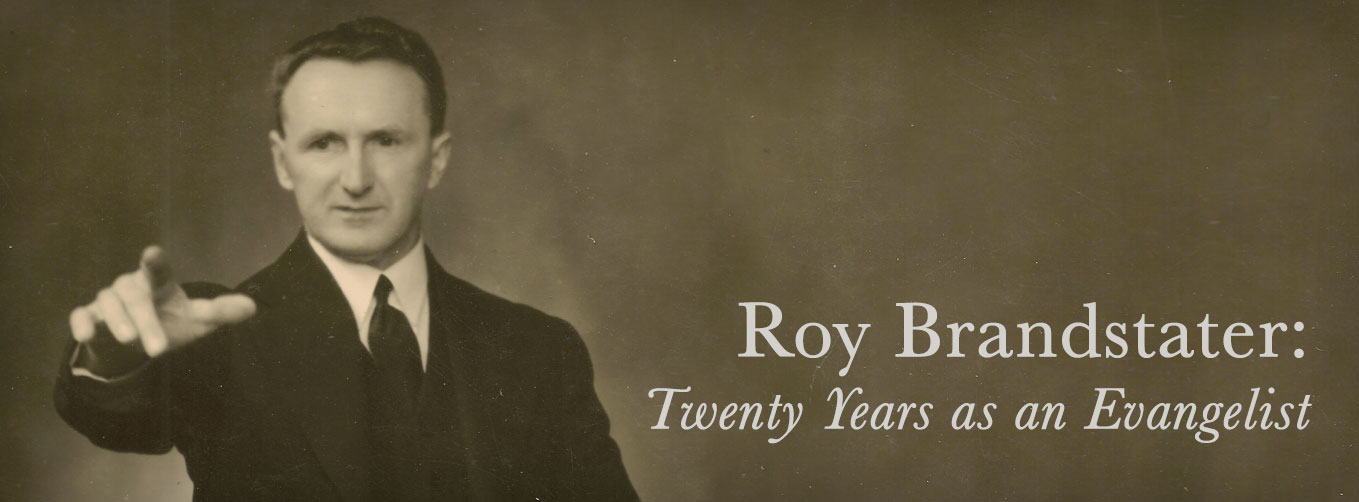
Roy Brandstater: Twenty Years as an Evangelist
California State University, Fullerton
Oral History Program
Roy Brandstater, interviewed by Maurice Hodgen on June 28, 30, and July 4, 1976
Introduction
The Advent awakening of the eighteen forties was carried on the words of evangelists. Later, in the mid-sixties, Seventh-day Adventism emerged, led by such as Joseph Bates, James White, John Loughborough, John Andrews and Stephen Haskell, most of whom spent many years as evangelists before and after the formal organization of the denomination. The whole experience of the denomination was suffused by the spirit and practice of evangelism from an early date, and led almost predictably to evangelism outside the United States as the enthusiasm of Protestant missions combined with growing resources within Adventism. The first Adventist missionary to be sent from the United States, John N. Andrews, went to Europe in 1874 where he found that evangelists had already in many places laid a foundation for his work. Ten years later in May, 1885, about a dozen Adventists left the United States to propogate their faith in Australia. They erected a tent in suburban Melbourne in October of that year, holding meetings there almost every night for three months. Other series of meetings followed. Three years later the evangelists went to Tasmania where, in Collinsvale, the family of Royal Brandstater (1898 – ) joined the church.
So much Seventh-day Adventist history is tied up with the history of its evangelists, who, for fifty years or more were the advance guard of their denomination. In rented halls, or more often, in large tents they preached to congregations large and small. The only common feature of these congregations was that few if any were Seventh-day Adventists on the opening night as the evangelist preached to draw them back again and on, through Bible study and personal conviction, into the church company that would be organized at the end of the meetings.
The style of evangelism among Adventists in Australia was remarkably constant through these years, probably reflecting a steady society and a constant intellectual and doctrinal orientation in the denomination. Prophetic preaching dominated, stressing the veracity of scripture–“the more sure word”–the confluence of current events in the imminent second advent of Christ, and the need of personal preparation, which included membership in the Adventist church. Within each administrative unit of the denomination a number of evangelists worked at any one time to swell the ranks of the church. Some were more successful and durable than others.
Royal Brandstater was one such evangelist in Australia, first in West Australia and then in New South Wales. He began his ministry in 1921, a fresh graduate of the Ministers Course of Australasian Missionary College. In his reminiscences of the succeeding twenty or more years we see him learning his craft as the assistant of more experienced men; later taking charge of his own meetings; using his musical skills to enrich his ministry; raising a family. And always the evangelist was on the move: from town to town to hold series of meetings, and within an area while preaching there; visiting, studying scripture with those interested, advertising. Evangelism continues to be a major concern of the Adventist church in Australia but its mode has shifted from the tents and travels of those earlier years so interestingly unfolded here through the medium of oral history.
Maurice Hodgen, 1976
My first correspondence was—as my mother told me—a telegram to me on the day of my birth, November 1, 1926 in Perth, Western Australia:
“Welcome little citizen—“
Possibly two to three years later I remember holding a little enamel mug in my hand up to the teat of a cow which my father was milking and having him fill the mug with warm milk. It was sweet and comforting. Why my father needed a cow has puzzled me in my adult life. True, he was reared as a somewhat farm boy, but after he became a preacher and traveled from city to city he still bought cows and milked them daily for his growing family. When Bernard became old enough it was his job to do the milking while Murray or I held the tail of the cow after roping the rear leg so the cow wouldn’t kick the bucket. We asked no questions —and we were smart kids—having a cow in the city was the accepted thing to do. I can even remember Dad sharing expenses of feeding a cow with a neighboring family—and then sharing milk with them in return. The routine was that after our family moved to a new city Dad would attend a cattle auction, buy a cow and then walk it home to the place where it was to be kept– usually the rear of our house if had a large lot, or an empty lot (preferably grassy) nearby.
When l was about four years old my father was moved from Western Australia to New South Wales, specifically the coal mine area incorporating Cessnock, Maitland and Kurri Kurri. I traveled with him in the train across the great Australian plains where the rails go, at one stage, 200 miles with no curve. The only thing memorable was stopping in the middle of the desert and having people with big black faces look up at us. holding articles for sale. An exotic memory—but that’s all which was imprinted on my mind till Kurri Kurri.
Kurri Kurri was a happy time. Memories of a small cozy house, sunshine through the windows, a piano in the front room, sitting down to a plate of fresh-cooked oatmeal at the kitchen table, followed by my parents going into the front room where Dad would start singing, mother gamely accompanying him on the piano. There were three things of value in their lives—the piano, a new Broadwood, mother’s sewing machine and Dad’s motorbike with side-car. He was preacher in charge of three church communities and the time was the middle of the great depression. I didn’t know what was going on but talk about “the dole” registered in my ears often. There was not work for many coalminers and strikes were common. My father counseled and helped many of his parishioners.. I remember my father waking me one night and carrying me outside to see the sight of a huge fire at the head of one of the coal mines some distance away. Whether the fire was accidental I don’t know, but the firey sight is still in memory. Dad also got me out of bed another night to see Halley’s comet, the significance of which was lost on me.
It was in Kurri Kurri I became ill with whooping cough. It was a dreadful disease which I remember so well, because I couldn’t breathe and this gasping for air and the noise which accompanied—called a “whoop” because of the noisy inhalation was scary. I imagine this was the beginning of my health troubles; at age four. Today’s mothers have benefit of vaccines; I haven’t heard of children having whooping cough for many years.
The next move was Cessnock where I attended public school for the first time. I loved school and did well at it. My mother used to make me a sandwich every day which I remember, since no one else had the same—the filling was date with coconut -yummy—and then a banana. In Cessnock I had my tonsils and adenoids removed; I don’t know why but that seemed to be cure for continued throat infections. The morning of surgery my mother gave me a “good healthy breakfast” to give me strength for the day. The doctor said she nearly killed me. Poor Mum. She had no knowledge of sickness or hospitals.
Cessnock was also the place I began piano lessons. I remember the beginning book. One of the kind which Robert Pace would ridicule in Pedagogy Materials class. In the front was a large page with a picture of the note-value “tree”. The semibreve dividing into 2 minums, then 4 crotchets then 8 quavers, 16 semiquavers, 32 demsemiquavers and I think even 64 hemidemsemiquavers!. Awesome! However, I made sense of it because within a short time I accompanied a group of children at a church fair as they sang a song about flowers. (They were all dressed as flowers in glued-together paper dresses) I can still remember the sound of the phrase: “Won’t you buy my pretty flowers…”
Maitland was a period of more school, this time learning sewing which I have realized was a very important skill for girls and am forever glad that the Australian school system incorporated it in the curriculum. I enjoyed the creativity of making things. I continued to be sick—temperatures, coughs, infections and a dramatic appendicitis for which Mother gave me a hefty dose of castor oil. Then a quick car ride to Doctor McMahon in the next town, emergency surgery and again a report to my mother that she almost killed me with the castor oil. Poor mum again.
All through this period Dad was officially an evangelist. He’d go to a new town, pitch a big tent, advertize and preach on the Revelation and Daniel prophecies. There was always a younger preacher with him—the “tent boy” who assisted him by maintaining the tent, taking care of upkeep, lights, hymn books, piano etc. He always had a little corner behind the stage where he slept and kept personal belongings. Where was his bathroom, kitchen? I don’t know. However, it was considered a privilege to be assistant to my Dad who usually ran successful campaigns which ended in Bible studies and baptisms. I remember several successful preachers in later years commenting on their experiences with Dad. As for Bernard and me—the smell of sawdust, canvas chairs, the charcoal heaters are forever joined up with mockups of the Daniel 2 image, charts of the four-headed beast, the wicked horn with eyes of a man, the four horses, and scary stories of end-time events.
I’m not too sure of chronology about here. I remember going with Mum and Bernard to Tasmania for a while—maybe a year. We stayed with Aunt Ida and Aunt Lydia during this period. I remember hush-hush talk about a lost baby; maybe Mum had had a miscarriage but it was never talked about to us. However Mother did give birth to Murray while we were there. The little country school at Collinsvale—6 grades to a room—was an experience remembered with pleasure. When I think back on the shadowy images I always remember the story of George Washington and the cherry tree. I think that was a report I must have given to the class while there. Mornings walking to school were very cold. Tasmania was cold—ice on the puddles.
Life became serious when we lived in Sydney. We had a nice large rented house. As usual Dad had the big front room as his “study” with his books, files, notes. The parlor became the parents’ bedroom and we children slept on a porch or behind a screen on the verandah. The third bedroom and/or dining room were rented. Life was penurious. And the conference kept Dad busy. I remember he’d get a sheet every month telling him where he’d preach every week. Every week was a different church (about 30 churches in the city) so there was no opportunity to become well acquainted with individual members of churches.
It was here that I won a position to the elite girls’ school, Fort Street which was adjacent to the road entrance of the Sydney Harbor Bridge at that time. How proud my parents were, that I was chosen to attend and they saw me off daily; I think I rode a tram and an underground train, followed by a walk to school. Discipline included exact uniform, hat brim turned down, gloves, blazer. No chewing gum, no talking loudly. I engaged in the whole program. Introduction to Algebra was interesting. You’d hear about this awesome subject; then the teacher wrote x+x =2x on the board. I understood the logic immediately while my fellow students puzzled. Why? The school motto was “Every girl is the maker of her own fortune”.
From Sydney Dad was transferred to Wollongong. A nice town where we lived on the road which followed the beach—a fabulous location except that World War 2 was declared while we were there and all kinds of prohibitions on lights and activities were put into effect. Gas was rationed, we expected the Japs to invade, barbed wire was rolled along our beaches to discouraged submarine landing! At school we had air raid drills, dug zig-zag trenches in the playground and listened to gruesome news night after night. Worrysome, scary. Dad had a successful evangelistic series in Wollongong and while here he was responsible for building a new church building -arranging the acquiring of land, planning the building and all that goes on with such a project. Dad was quite resourceful, capable and willing to “give-it-a-go”. He was a valuable conference employee. Bernard and I continued to take piano lessons and by this time were becoming proficient. In fact, at this time I became capable of accompanying in church—I was 14-15 years’ old. Lynne was born while we lived in Wollongong. We were crazy for her!
For some reason Dad was sent on to Bathurst, beyond the Blue mountains west of Sydney. The war was still on, shortages of everything. I remember Dad driving at night with tiny slits for headlights; you couldn’t see where you were going so crept along VERY slowly. Mostly we stayed inside at night with blackout curtains on all the windows. Yes, the war was very real to us and the government was continuing to give requirements for this and that. Gas rationing was on and there were shortages of different kinds—food, clothing, building materials etc. Even so, Dad managed to build us a house which was his first effort at improving our family financial health. He borrowed from a Building and Loan Society and somehow we became owners of property. Mother picked up the challenge and, besides renting out rooms, she walked to a canning factory nearby where she worked canning asparagus. The kids accepted it, but now I think of it I’m unhappy that it was necessary. I guess building a house took resources, I guess the war effort was on our minds, I guess she earned good money.
Anyway, we had at least three years in Bathurst and it was here that I graduated from High School. Education finally made sense to me. I relished the study of History, Shakespeare, the Romantic poets and especially Chemistry. I had a terrific teacher—wish I had told him so at a later date—who organized the study of the subject in a logical, understandable way, and I latched on to it as I did Algebra at Fort Street. I read the story of Madame Curie which took me on a romantic vision of what I wanted to do with my life—discover some remarkable cure for cancer, or new element or shake the halls of learning. My parents wanted me to be a school teacher; I wanted to be a research chemist.
From Bathurst Dad was moved to Adelaide, South Australia to be in charge of youth work. I think Dad built a house there, too, on Kensington Road and we continued family routines-music and school. I enrolled in Adelaide University in a Science degree program. I found university a challenge. Students were on their own; they attended classes or not, they studied or not and they were tested at the end of the year with exams in with a hundred or so others massed in the big hall. Tough questions, often essay, definitely not multiple choice.
We lived on Kensington Road and I commuted to the University by tram, which had a regular stop about a block away. I worked part-time at the Sanitarium Health Food factory to earn money for my daily needs—perhaps two or three days or afternoons a week. The job was filling boxes with candy, dried fruit and nuts for sale in the retail store. Not intellectually stimulating but a little help for the family budget.
War was still on everyone’s mind. Battleships being sunk, bombing of London, the king and queen visiting Coventry Cathedral were all big stories. The Coventry story especially created a reverberation of patriotism, and together with speeches by Winston Churchill, and the bombing of German cities we were sure we were going to win the war. I remember well the newspaper headlines “JAPAN ATTACKS ON PACIFIC FLEETS” which brought the US into the war, the June landing on France, Dunkirk, allied armies sweeping across Europe and the creeping of the Japs south as they progressed through the Pacific Islands towards Australia. This occurred when we were in Wollongong and I think we were glad to be away from the coast line of Wollongong with it’s nearby munitions factories and attractive little harbor.
One day as I was waiting for my tram ride home after University classes I looked at the headlines on my neighbor’s newspaper. Big print about US dropping an atomic bomb on Nagasaki and subsequent devastation. Then two or three days later came another biggy about another bomb on Tokyo and an immediate ending to the Pacific war. The memories of those times are vivid. At this time there were soldiers everywhere—Yanks (as we called them) and Australian. Every Saturday night they had a big dance for them and any others who wanted to join. I desperately wanted to participate—it looked so much fun and I was the impressionable age, about 18 or 19. But my relationship to the family and church kept me just watching. However we did see my airman cousin—Geoff Brandstater— occasionally and I was proud of him. A handsome guy in an airman’s uniform, and he was my cousin.
When I graduated from University with a major in Bacteriology and Organic Chemistry I looked for future prospects. I said “no” to a government job in New Guinea and decided to go to Avondale for a year to enjoy music and art which it offered. I loved it and made terrific friends while there. On top of that I was given a job teaching math—an early morning class if I remember and worked in the food research laboratory. The food research was to monitor the amount of vitamins which were in batches of cereal. The work was petty routine, but earning money to pay my room and board.
Memorable contacts while at Avondale were George and Hazel Greer, and Yvonne Howard who had come from the US to set up a viable music department, such as existed in American Adventist colleges. The experiment was successful—Greer’s choir becoming well-known and Yvonne Howard nurturing piano students and teaching music history and theory. I expect it was the influence of the US connections, with the glamorous idea of overseas travel and experience that finally induced me and my fellow musicians Heather Sprengel and Zelma Harris to eventually travel to the US.
By this time Maurice and I had developed a friendship. I had noticed him first as he walked to the chapel with a book of Bacon’s essays under his arm — extraordinary for an ordinary first-year Avondale student. Then on another morning I approached a conversational group on the sidewalk, proudly showing off an orange that one of my early morning math students had given me. Maurice said: “Did he say to you, ‘I give you the orange, you give me the pip?’” That was a beauty and I sought his company after that.
At Avondale, besides working at the SHF laboratory and teaching Math, I took a few classes. Daniel and Revelation from N.C. Burns (“Nubby”, who was a dramatic violin soloist), History of Education from Mc— and an Art class from Howard Totenhofer, who painted and sold many lovely oil and watercolor paintings of Australian landscapes. I think he was the person who started me on my life-long experimental art journey. Of course, my mother took me to art galleries and there was conversation about the artists’ shows; so I guess that also entered into my interest in the whole field. And, come to think of it, how many high school students in Wollongong or Bathurst had mothers who took them to art galleries for pleasure?
Maurice and I were married in the Avondale church; Bernard as best man, Neridah and Lynne as bridesmaids. We had the reception in the Greer’s home, brief honeymoon in Sydney and lived with Cam and Joan Myers (Joan was Maurice’s sister) while we were waiting for our visas to go to the US where Maurice wanted to do graduate study. Maurice’s goal was to get a graduate degree in the US and return to Australia to teach—maybe at Avondale; I don’t remember that detail. I remember that we were very short of funds and I don’t know how we survived the next year or two. But we were in love and had stars in our eyes and some friends who believed in us—Neridah’s mother helped us with our boat fares. We hoped to get jobs in the US for a year in order to save the money for education.
The boat passage from Sydney to Vancouver was a pleasure but uneventful except for the break in Honolulu where we were met by a resident physician and given a tour of the city. His driving on the right side of the road was terrifying! I must say that the experience of leaving one’s home country and getting an objective look at it from afar is sobering—I had never jumped out of my comfortable patriotic position in my world-view thinking. This was my first change of orientation to the future which awaited us.
Pastor Roy Brandstater was a pioneer Seventh-day Adventist preacher-evangelist in several country towns in Western Australia during the nineteen-twenties. He spent 1925 and 1926 in Manjimup, and fifty years later he wrote memoirs that recall some vivid pictures of those early years of church growth, and what a minister’s work was like in those days. He was especially proud of his first church building project, the church in Manjimup, completed when he was an inexperienced young minister, still single, fresh out of college. This article is an extract from his memoirs.
One of my earliest experiences after leaving Avondale College was being sent down to work in Manjimup in the southwest, the big timber country. There was already a small company of Adventist believers in Manjimup. The Clark family was well known, and Lewen Clark was a great help to me providing transport in his horse and sulky to outlying settlements. The Giblets were another fine pioneering Adventist family, and it was in their old homestead in Springdale that we used to hold Sabbath services. A grand old place it was, built of unfinished split lumbar planks, and with little more than the bare necessities for human habitation. Thirty miles away in the forest was another small Adventist group, amongst who were the Scott family. The distinctive beliefs and worship style of these people were well known in the district. When they cut a road through the forest to simplify their travel into Manjimup to attend Sabbath services on Saturday, the local people named it SEVEN DAY ROAD, and the name remains to this day. All these believers in the district traced their religious loyalties back to the early pioneer preaching of Inkster and Pallant, many years before.
As a young minister just out of college, I was expected to take care of this company of believers. But in those years our watch cry was evangelism. My special assignment was to do evangelistic work amongst the Group Settlers. These were English immigrants who were brought out by the thousand by the
Western Australian Government after World War I, with the goal of opening up the rich, well-watered, heavily timbered country of the southwest. When the settlers arrived from England, where most of them had never seen a cow or a horse, they were brought from Perth by truck. Each family was given one hundred and fifty acres of land and a galvanized iron shack to live in, just a crude temporary affair. A “group” consisted of twenty of these shacks, built in a clearing hacked out of the forest, with an Australian man appointed as group foreman. Throughout that country, for many, many miles, there were hundreds of such group settlements.
For all these settlers one thing was missing: any formal arrangement for worship or church attendance. The Conference office in Perth had sent out thousands of copies of the “Signs of the Times”, almost flooding the groups with our magazine. After all this effort and expense, our church leaders felt that it was time to send someone to personally work among these people. And I was the man they sent. It was a challenge for me, with no one to tell me how to begin.
At first I boarded with the Clark family. The very first group I went to, in Clark’s sulky, was Group No. 135, twelve miles out of Manjimup. All the shacks were placed around a huge jarrah tree. Beyond the shacks for miles was heavy forest country. I simply stood under the big tree, took out my trusty Avondale cornet, and played a few tunes. People stuck their heads out from shack doors all around. From one shack a fellow came with a cornet in his hand. He stood beside me and said: “I can play, too.” I pulled out a hymnbook, and soon we were playing fine duets together. Of course, children came and stood around, as they usually do. I told the people I would be having a meeting there every Sunday afternoon, and that they should come and bring their seats. There was no factory-made furniture, of course, just rough stools they made out of bush timber. I would arrive each week, and play a few tunes on my cornet. This was the signal, and the people would gather with their stools. I had a congregation ready-made. There were no other Sunday meetings or services, so I preached there for several months. Some of the people joined the church. The man who had played the cornet with me joined the church and his family too. Their name was Noble, and they lived up to their name. Later he used to come into Manjimup to serve as solo cornetlst in the local town band, after the townspeople had invited me to be its conductor.
Scattered amongst the group settlements there were a few large timber mills. Each mill was really a large community in itself, with a hundred or more houses for the workers. Each mill would have a community hall which was available free to any minister in turn. I decided it would be a good idea to hold some meetings in a large mill just beyond the group I had been working with. I made the necessary arrangements by going to see the Church of England minister in Manjimup, saying: “I want to hold some meetings in Number One Mill”. He replied: “That’s frightful!” But I wasn’t going to be put off, and said: “Well, now I have made the arrangements, and I’ll be there next Sunday night to take my turn.”
Of course, he didn’t want a Seventh-day Adventist to go there to preach, but under the existing rules he could not stop me. By that time I had a horse of my own and I would ride out there each Sunday evening, arriving at five o’clock or a little later. There I’d stand on the steps of the hall, with the hundred or so houses below, and I’d begin to play on the cornet. The meeting had been announced already by a public notice. When they heard the cornet the people would come up the hill and would fill that hall. Then I’d preach to them. It was a good arrangement as I always had a good congregation. The trouble was I was young and inexperienced, and hardly knew how to cope with the success. So many people came. Perhaps if I had had another man to help me we could have built up a more lasting interest and a permanent company.
Meanwhile the church group in Manjimup was growing. We had continued to meet in the old Giblet homestead in Springdale. But I thought we ought to have a church, and that we should go ahead and build it. The members were not convinced. They said: “Oh, we’ve been meeting here at Springdale for
twenty-two years, since the Message first came to us. We can meet here until the Lord comes. It won’t be long.” I told them in no uncertain terms what I thought: “More disgrace to you! I think we ought to have a church.” By this time I had hired a hall for services on Sabbath and there were more people attending regularly.
We already had a piece of land in the heart of town given to us by the government. I preached to the congregation pretty strongly on Sabbath on the need for a church and made an appeal to them. None of us had much money. I hadn’t much because I was getting only about four pounds a week. But I said, “I’ll give five pounds towards the church. Would anyone else like to give five or ten pounds?” Someone else gave five, then another also gave. Soon we had a hundred pounds promised, and written on the chalkboard, towards the cost of the church. That was a lot of money from our little group.
Brother Scott from thirty miles away down Seven Day Road said: “I haven’t any money, but I’ve got plenty of timber on my property. You can have it. It’s all standing up in the trees, but you can have it.” We started from there. Scott wanted to build a new house, and he said: “How about rigging up a sawmill? Then we can cut the timber, enough for the church, and my new house too.” And that’s what we did. Brother Escreet worked with us. He had retired from Avondale and had come to be with his daughter, Rose who had married Tom Scott. We had an old Fordson tractor to drive the saw. We rigged up a bench, and cut enough timber right there in the bush. My timber cutting and milling experience in old Colllnsvale stood me in good stead. With the timber all sawn, Jack Scott dragged it up by bullock team the full thirty miles to the church site in Manjlmup. And there it lay, waiting for the next move.
There were some stumps on the church property that had to be blasted out, so I got some gelignite to do the job. I put the stuff in some of the old stumps and it worked well. But it’s not an exact science, and in one I put a little too much. It went off with a bang you wouldn’t forget. Half the stump flew away in the air, and a large piece of it came hurtling down on a neighboring house and crashed clear through the roof. Luckily it was easily mended and no one was hurt.
When the land was cleared there was no one to actually do the building. Miles away at Pemberton there was an Adventist builder, but every time we tried to get him he was busy with other Jobs. At last I grew desperate, with all that good cut timber lying there, and no building going on. So I went to a contractor in town and asked for his help. He couldn’t do the job for us because he had no time. I told him if he would show me the moves I would build it myself, with whatever other help I could find. He agreed, came out to the site, and helped me mark it out: sixty feet long and twenty-five feet wide. I put down the foundation blocks, and laid the bearers and the joists, all by myself. Then I framed the walls, and asked Fred Fairall and one or two other members to come and help me raise them. We lifted them into place, plumbed them, and added the roof.
Those days I was handy with plumbing, thanks to doing a lot of it while working at Avondale, so I had no trouble making the water tank. Church members lent a hand when they could. We built our own baptismal font, bricked out by the Fairalls. We also built an extra room on the back of the church. Brother Escreet came and helped us make our own seats. We built the whole church, outside and inside, for the hundred pounds we had raised. It was the first Seventh-day Adventist church in the whole area, and was free of debt.
Comments by Bernard Brandstater:
In 1978 I rented a car in Perth and drove my parents, Roy and Frances, back to some of their old haunts in the south west of Western Australia. They were overwhelmed by the size and splendor of the new cream brick church in Manjimup. But their hearts were in the past. With help from others we found our way out to the old Springdale homestead where they had worshipped with the early believers. It still stands, a recognized historical monument to-day, because it is genuine pioneer construction, and few homesteads like it now remain. A host of memories came flooding back, of their meetings, their Bible studies, and the fragrant fresh bread the Giblets used to bake out in the yard in the brick oven, long since fallen into disrepair.
But it was the old church that was closest to Roy’s heart. He led us straight to it as if the fifty years had been but a moment. It is a modest wooden building by to-day’s standards, but in good repair, and painted in shades of brown. Father was relieved to know it was still standing, and still used for the worship of God, nowadays by a Baptist congregation. Because it was midweek, and our visit was hurried, we could not wait to meet with the worshippers. But we felt a love and kinship with them that they could never know or suspect. Roy examined the church minutely. He ran his hands tenderly over the rough sawn timbers he had helped cut down on Scott’s property in the forest. He caressed the window frames, and hauled himself up to snatch quick glances into the dim interior. It seemed to be just as he had left it. He said to me: “.May God bless these good people! No man can have greater joy than seeing his work live on after him.”
Comments by Murray Brandstater:
I visited Manjimup in 2008 with my sister Lynette and my wife Karen. We found the original church built by our father 86 years ago. It is still standing and is now recognized by the city as a local historical landmark. The Baptist congregation bought the property some years ago and built a large new church at the back of the old building, fronting on to the next street. The old SDA church is now used regularly for Sunday School services for children. We were able to inspect the interior through the help of a local member of the church and we had the opportunity for a thorough inspection inside and out. We were impressed with the building’s construction, simple, plain and unembellished, but functional, a classic 60 by 25 feet meeting hall. Its structure appeared solid and ready to stand for another 100 years.