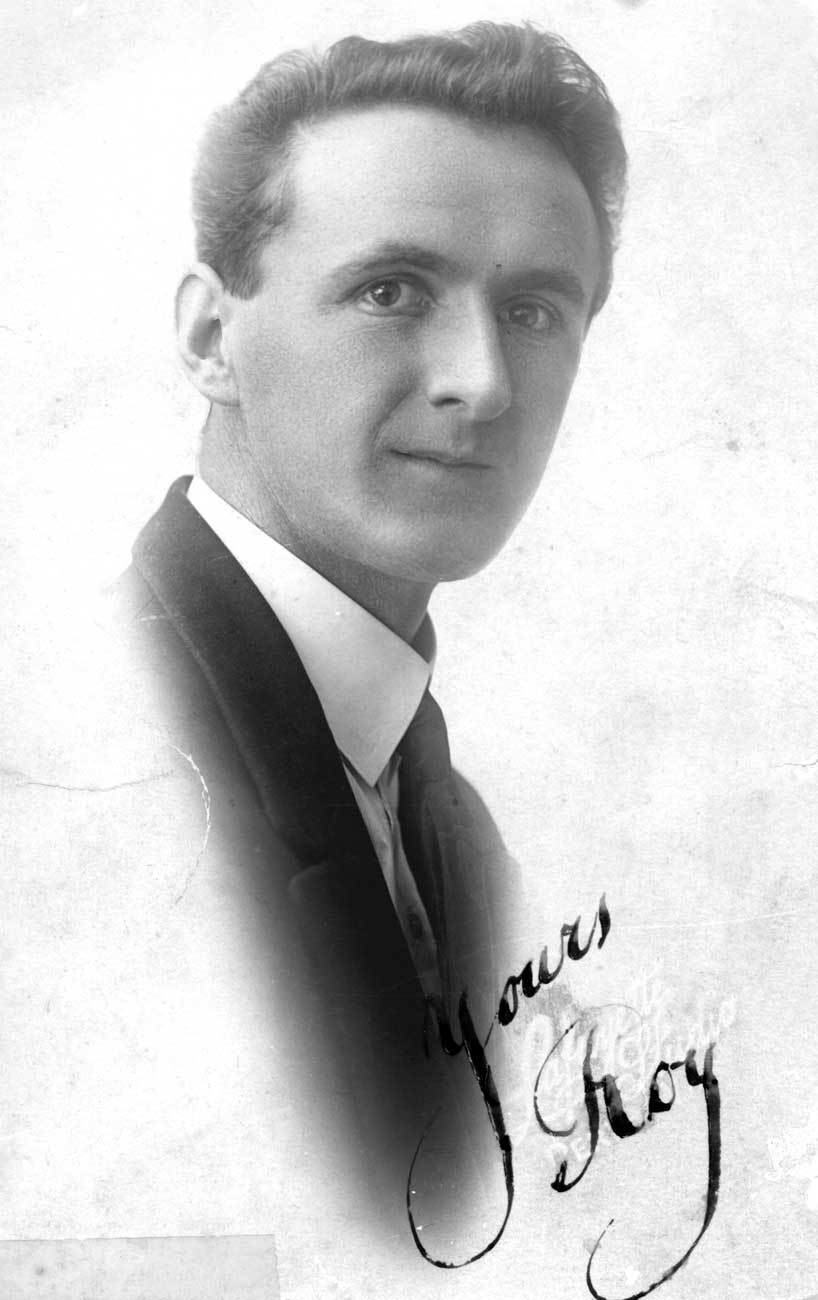
Born: 23rd February to Emanuel Brandstater Jr and Wilhemina Darko in Collinsvale, Tasmania, Australia
Married: Frances Eastwood on 5th January 1926 in Perth, Australia
Children: Rhona, Bernard John, Murray Everett and Lynette Frances Passed away: 23rd March 1983 in Redlands, California
Roy was born in Bismarck, now Collinsvale, in Tasmania in 1898, the last of eight children of Emanuel Brandstater Jr and Wilhemina, both immigrants from East Prussia. He married Frances Eastwood from Kalgoorlie, daughter of an English immigrant James Wilkinson Eastwood and Louise Everett, in 1926. They had four children, Rhona, Bernard, Murray and Lynette.
After attending primary school in Collinsvale, in 1914, at the age of 16, Roy traveled to Cooranbong, NSW where he attended Australasian Missionary College (Avondale), graduating in 1920 from the ministerial course. Roy’s life was committed to the Seventh-day Adventist Church which he served as evangelist, church pastor, conference department head and missionary until his retirement in 1973.
For the first 10 years of his professional life, Roy worked as an evangelist in country towns throughout Western Australia, reaching out to the public by advertising meetings to be held in a large tent or rented halls. He worked in Albany, Manjimup, Kalgoorlie, Boulder City, Merredin and Perth. It was in Manjimup that he was able to establish a new church which he personally constructed of wood with his own hands. He also established a new church in Merredin. In 1931 he relocated to northern NSW where he continued his evangelistic work in Kurri Kurri, Weston, Cessnock, Maitland, Tamworth and the suburbs of Sydney. During this time he took some photography classes and with a special camera he was able to produce large glass black and white lantern slides that were hand tinted in color by his wife Frances. He used these slides extensively to illustrate his evangelistic presentations. He was sent to Woollongong in 1938 where he had another successful mission and was responsible for construction of a church building that was dedicated in 1940. From 1941-3 he conducted his last evangelistic campaign in Bathurst.
From 1944 to 1952 Roy served as head of the church conference departments of Youth and Sabbath School in Adelaide, South Australia and then moved to Melbourne to serve as pastor of churches in Ringwood, then East Prahran and Fern Tree Gully, all suburban churches in Melbourne, Victoria. Rather than retire, Roy spent 2 years as church pastor in Bulawayo, Southern Rhodesia (now Zimbabwe), and six months pastoring in Nicosia, Cypress. Finally in 1969 he relocated with Frances to join their four children in California where he served for three years as pastor of the SDA church in Fallbrook until he retired in Redlands.
Roy’s wife Frances contributed greatly to his success in the ministry. Roy had a musical flair, and embellished his meetings by playing his cornet or singing solos in his fine tenor voice. Frances would play the piano for community hymns or accompany him as he sang. She added color to his black and white lantern slides and painted many of his public advertising signs. And she was always willing to pack up her family and follow Roy wherever he was sent to serve. During his retirement in Redlands Roy started and directed a choir called Heritage Singers that specialized in Early Advent hymns and which gave performances in Southern California. Roy died peacefully in his sleep in Redlands in 1983.
Author: Murray Brandstater, son of Roy and Frances Brandstater
Louise Brandstater is little known or remembered by the Australian Brandstater family, and is commonly overlooked as a member of the First Family in East Prussia.
She was born in 1864, the second child of Emanuel 1 and Wilhemina (née Justies) Brandstädter during their early years in Konigsberg. She was reported at first to be a normal active baby, but it was soon noticed she was not responding to sounds around her, and later tests confirmed that she was deaf.
Her deafness, without known cause, was a major issue when Emanuel 1 and his second wife Carolina prepared to migrate to Tasmania, their ship’s passage to be financed by travel assistance awarded by the colonial government in Hobart. But this daughter, handicapped by a hearing disability, was judged in Hobart to be unsuitable as an assisted immigrant. In response, the family bravely decided to stick with their emigration plans. Louise could live in a farmhouse with two Brandstädter aunts, sisters of Emanuel 1, who lived in the village of Seehausen (“houses by the lake”), located in the estate called Gut Puspern. They believed that once they were established in Tasmania, they could save enough money to pay for travel expenses, and bring Louise to join the rest of them in Tasmania.
But in East Prussia, Louise’s hearing disability continued to overshadow her life. Though intelligent and physically active as a growing child, she could not hear spoken words or learn to speak the German speech all around her. She learned to get along well using mostly sign language and had many friends. She became known everywhere by a nickname “Stummchen”, which means “Dear deaf one”. Apparently she did achieve some verbal skills at school, however, which we know from the handwritten letters she later exchanged, in German, with her brother Gustav Adolph, then in Australia.
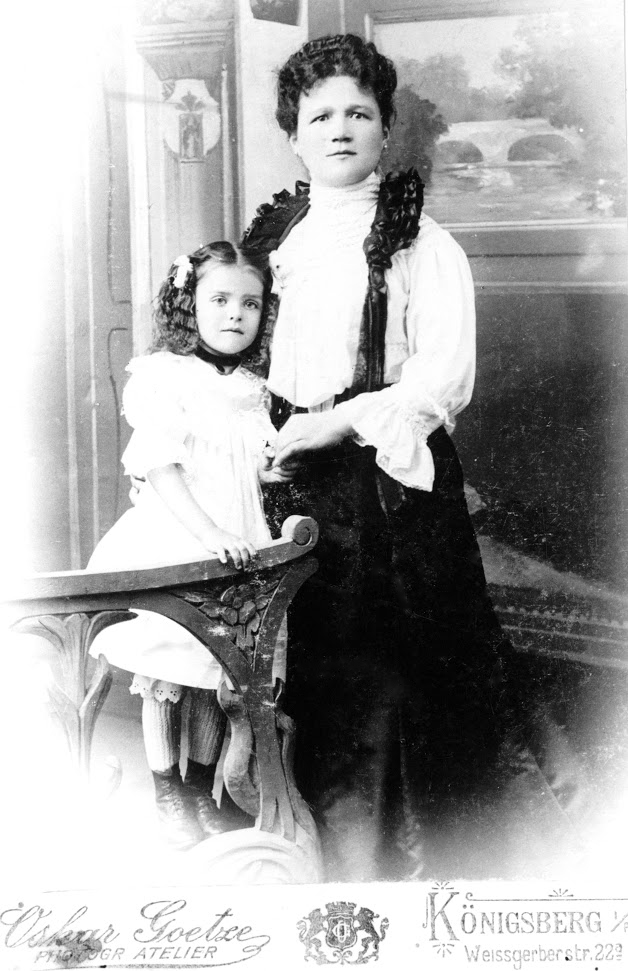
After finishing school, as a bright, well-developed and active teenage girl, Louise was judged capable of significant work in the estate. She was made responsible for the upkeep and laundering of all the linens in the manor house. She performed this work well, with a pleasing, smiling demeanor, and she caught the admiring attention of the lord of the estate, Fritz Kaswurm. He was attracted to her, and in time she became pregnant, gaving birth to a healthy daughter she named Louise Brandstater, like herself. This baby was accepted as the master’s child and was widely admired and loved in the estate. This daughter, Louise 2, at the end of her schooling in Puspern, was sent for higher cultural education in an elite girls’ school in Berlin at a time when her Australian-born cousins were attending English schools in Tasmania. As an attractive young woman in Berlin, she met Wilhelm Beutenmuller. The two were married and produced a family, described elsewhere in this website. Years later Louise produced a second daughter by Fritz Kaswurm, who is pictured below with a middle-aged Louise 2, but we have no further information about her.
Meanwhile, Stummchen remained employed at Gut Puspern, and became the house-mother in charge of six teenage children of the Bakschat family. Onkel Wilhelm Bakschat was the hofkamerer, the work manager, of the whole 50,000-acre estate. At some time during this period, Louise received money from two of her brothers in Australia, Gustav Adolph and Herman. And she fulfilled her dream of joining the rest of her family in faraway Bismarck. She tried to adjust to the humble standards of life in a Tasmanian farmhouse. But her deafness remained a handicap, and though her family knew German language, they did not easily adjust to her sign language and her use of some German words. Also, the familiar friends she had known all her life were back in Gut Puspern, and making new friends in English Tasmania was slow and difficult. The family reunion turned out to be less fulfilling than she and the family had hoped. So eventually they cut their losses, and Louise returned to the land and the people she knew and trusted.
One episode remains to be mentioned. It was Stummchen’s assignment to live her retirement years in an institution for disabled persons in the city of Angeborg. Many years later, in 1987, the writer of this life-story, Bernard Brandstater, visited this very institution accompanied by Louise’s grandson, named Wilhelm (Willi) Beutenmuller. The old buildings, still functioning in their historic role as a refuge for elderly disabled persons, are located in a Polish city of different name. When we visited, it did appear to be a dreary, unwelcoming place. From his childhood in Berlin, Willi had been told by his mother, Louise 2, about this sad experience of his beloved grandmother, how she had been miserable there, and had begged, weeping, to return to Puspern. Finally her old friends back there had accepted her back to live out her life in familiar surroundings.
Louise died in 1937, though the circumstances of her passing are unknown to us. She is interred in a majestic grave in the town originally known as Eilau in East Prussia. We have a good photo of her grave, but have no knowledge of its exact location. She is the great-aunt I wish I had once known.
Written by Bernard Brandstater, assisted by Wilhelm Beutenmuller.